Computing Zigzag Persistence with HDVF
Introduction
Persistent homology: add simplices, track holes

Zigzag persistent homology: add or remove simplices, track holes

Practical algorithms:
- Carlsson, de Silva, Morozov (2009) 📄: simple algorithm, convoluted theory.
- Maria, Oudot (2015) 📄: different approach and algorithm.
- Dey, Hou (2022) 📄: offline algorithm, just computes persistent homology, fastest.
Same time complexity: \(\mathcal{O}(n \cdot m^2)\), where
- n: number of steps in the filtration
- m: size of largest simplicial complex
Motivation:
- More straightforward algorithm
- with same complexity
Menu of the day:
- Easy explanation of zigzag persistent homology
- \(\mathcal{O}(n \cdot m^2)\) algorithm for zigzag persistent relative homology
Homology
(with Homological Discrete Vector Fields)
Simplicial complex
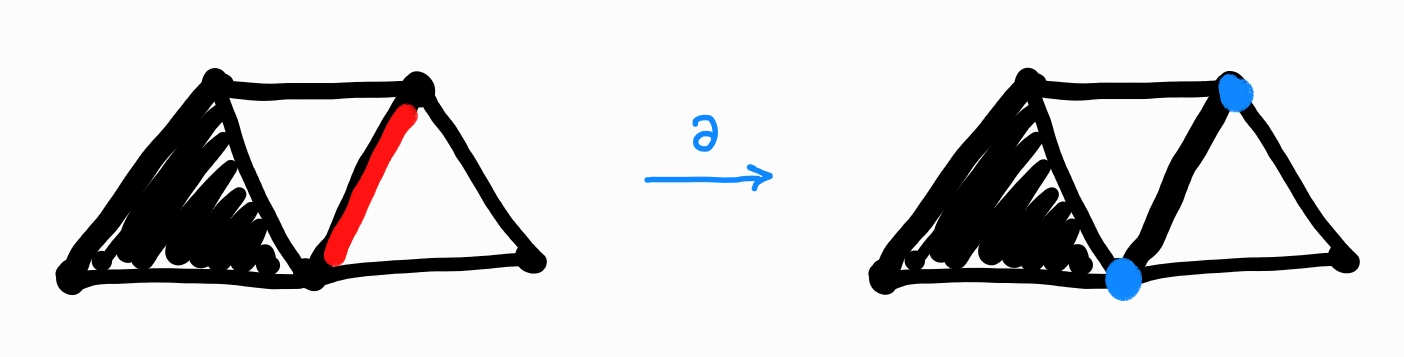
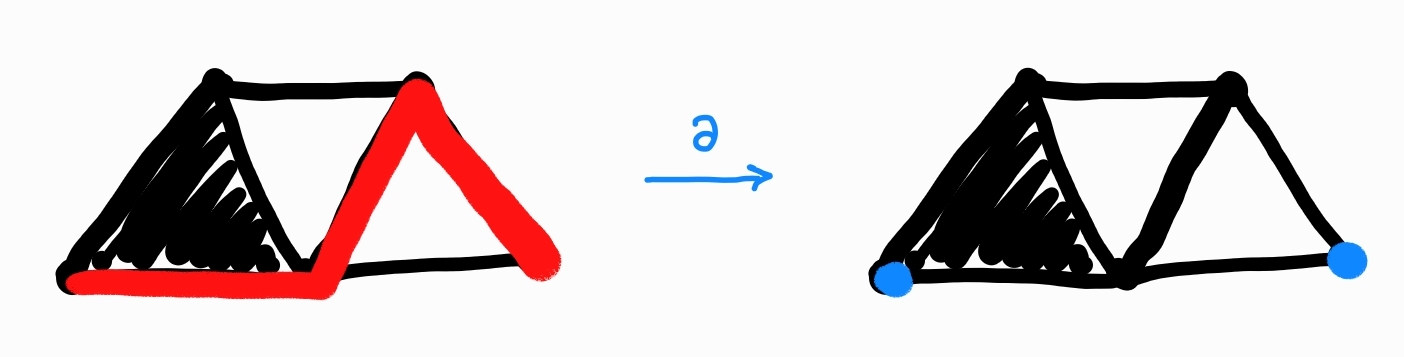

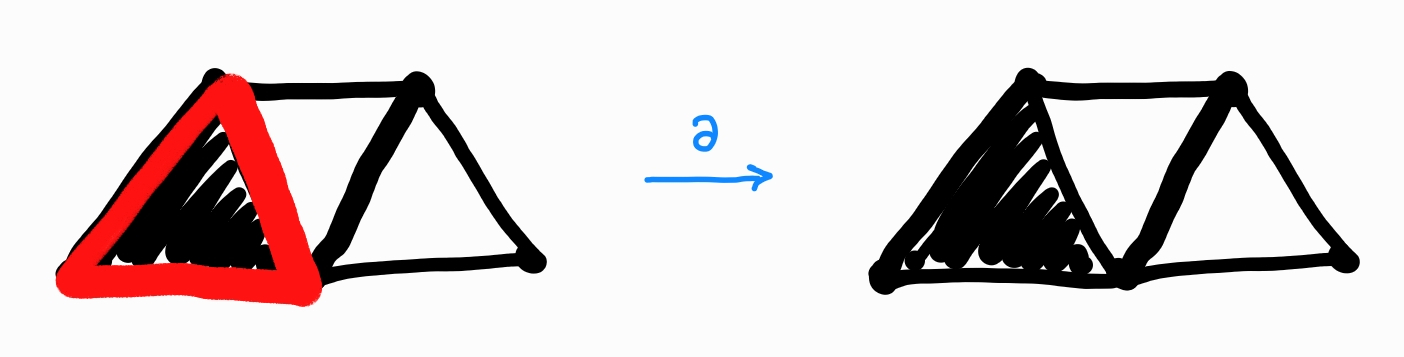
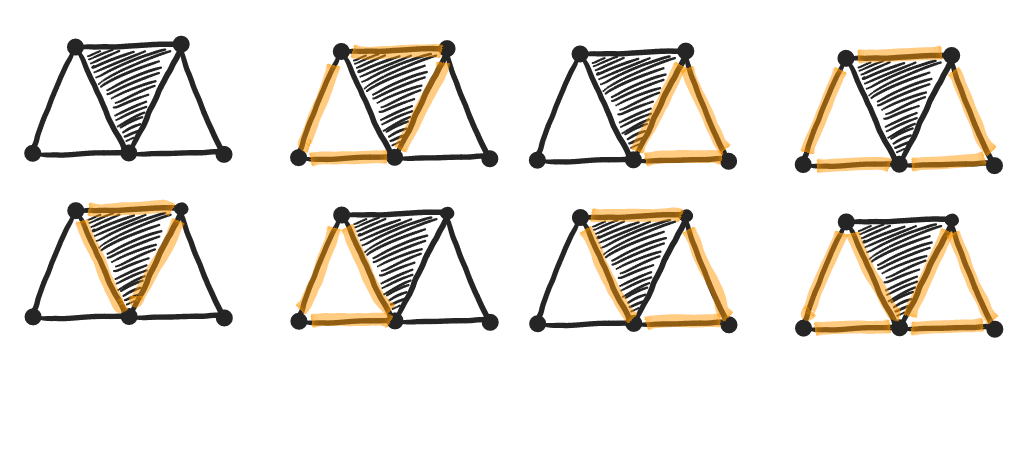
Homology group
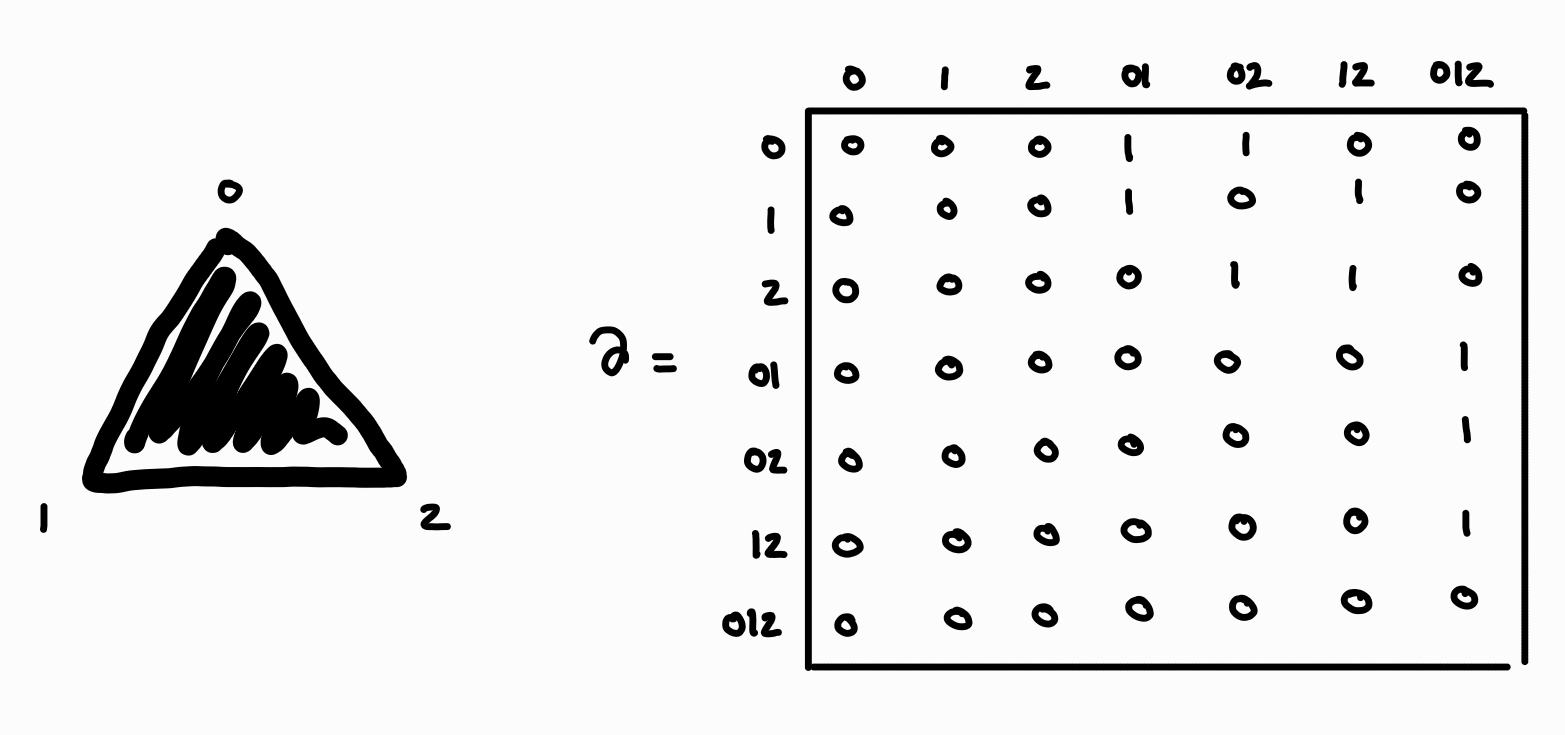
\(H(K) := \text{ker}(\partial) / \text{im}(\partial)\)
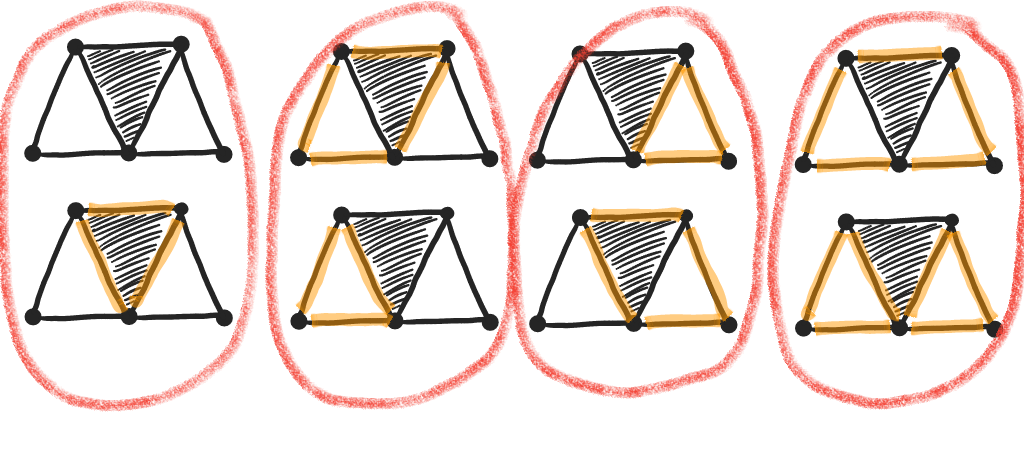
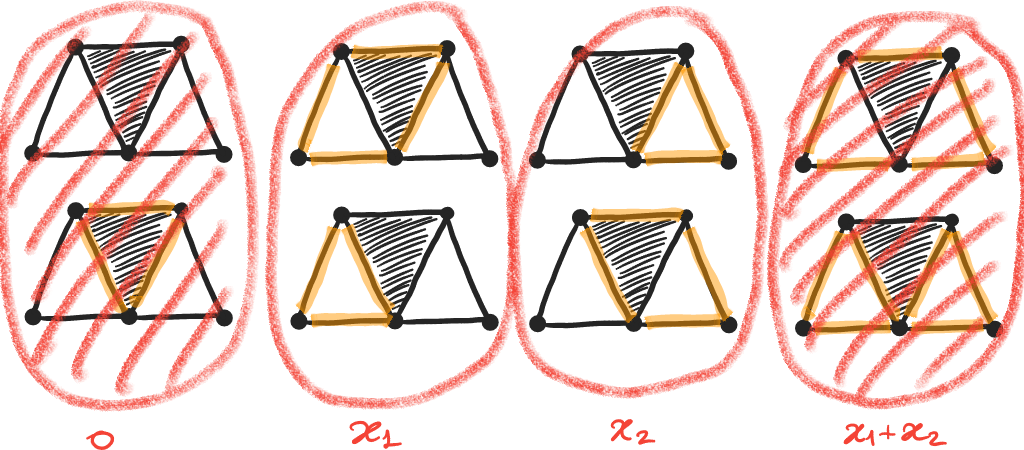
HDVF
Let \(K\) be a simplicial complex. Let \(P, S \subset K, P \cap S = \emptyset\).
A pair \(X = (P, S)\) is a homological discrete vector field if \(d(S)_{|P}\) is an invertible matrix.
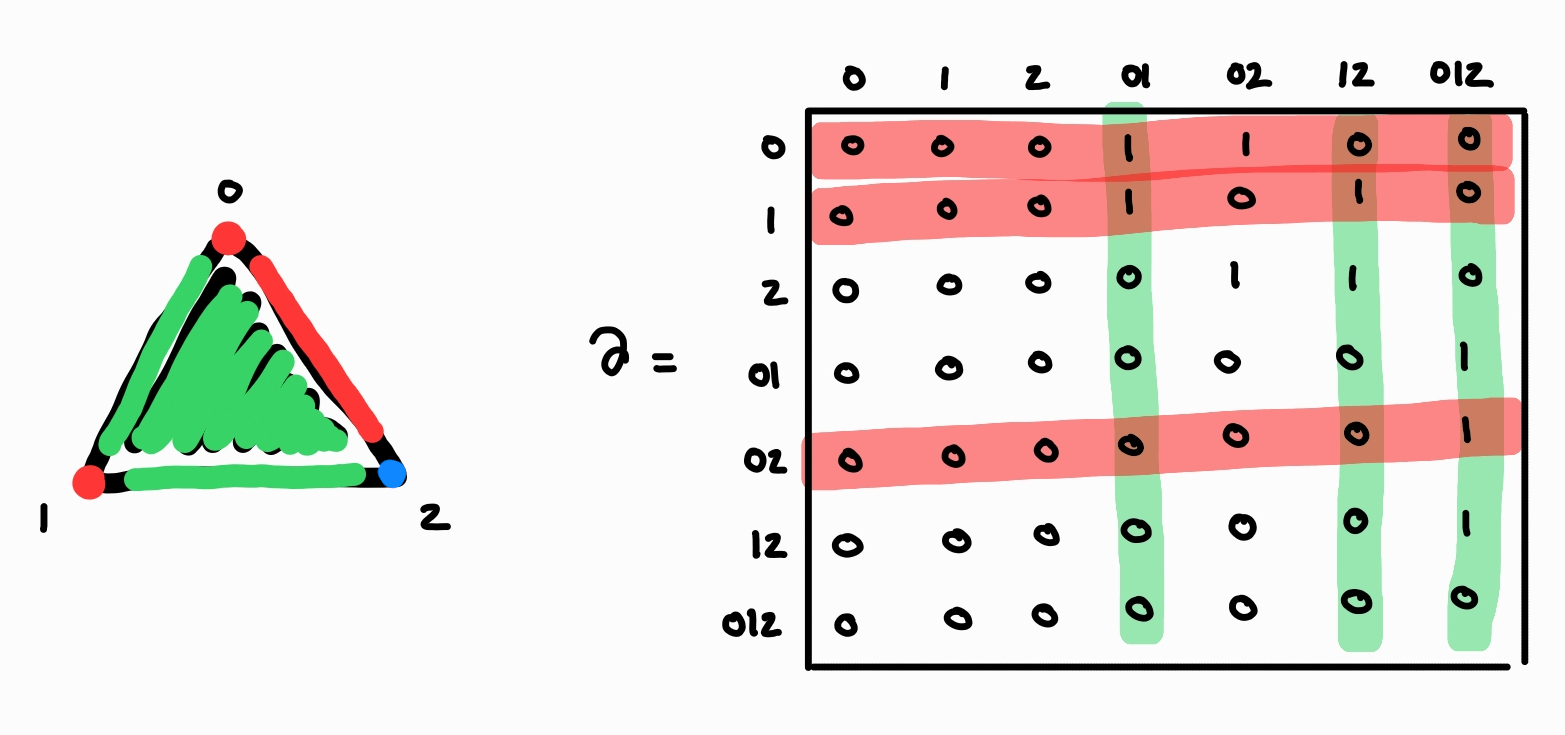
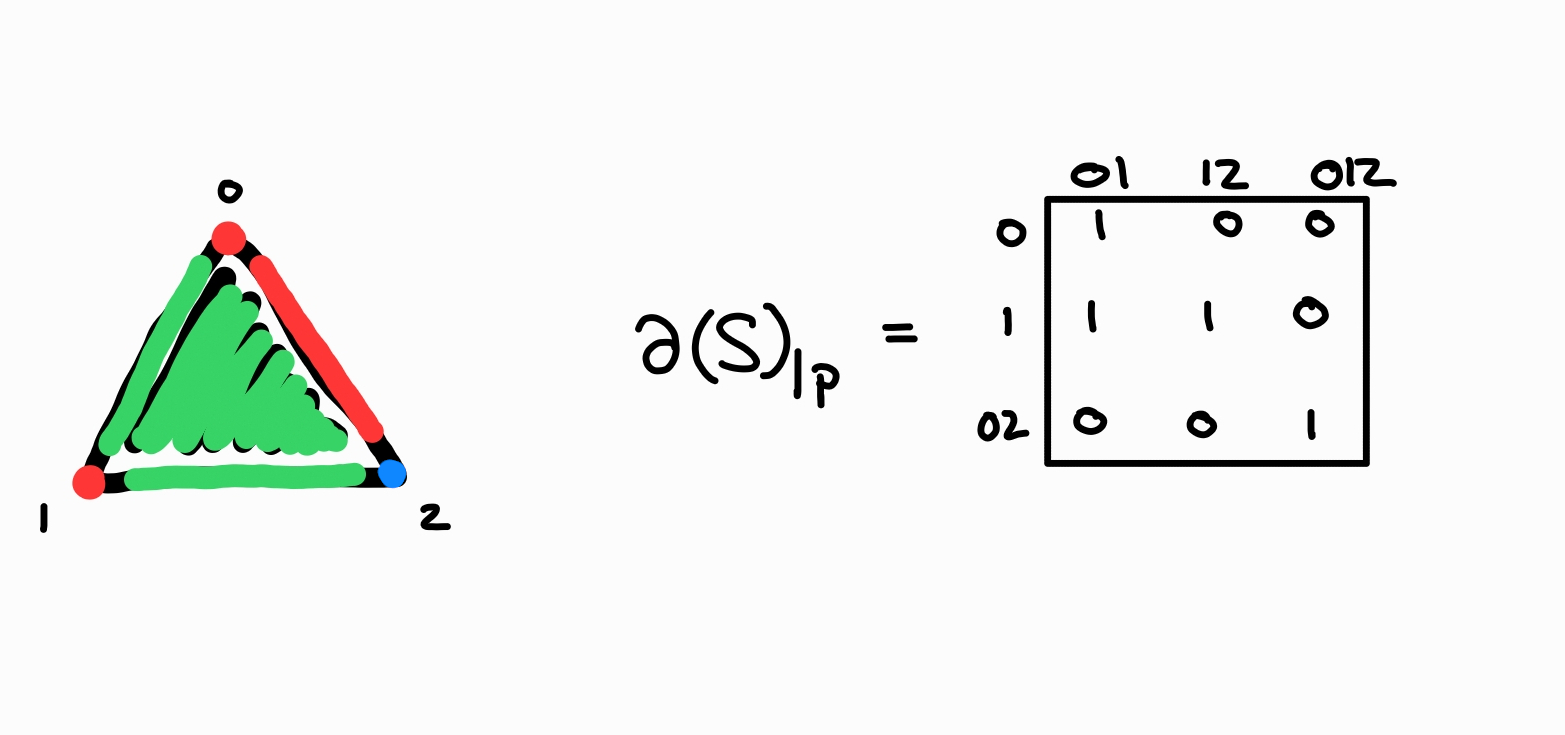
Its associated reduction: four maps \((f, g, h, d)\) carrying homological information.
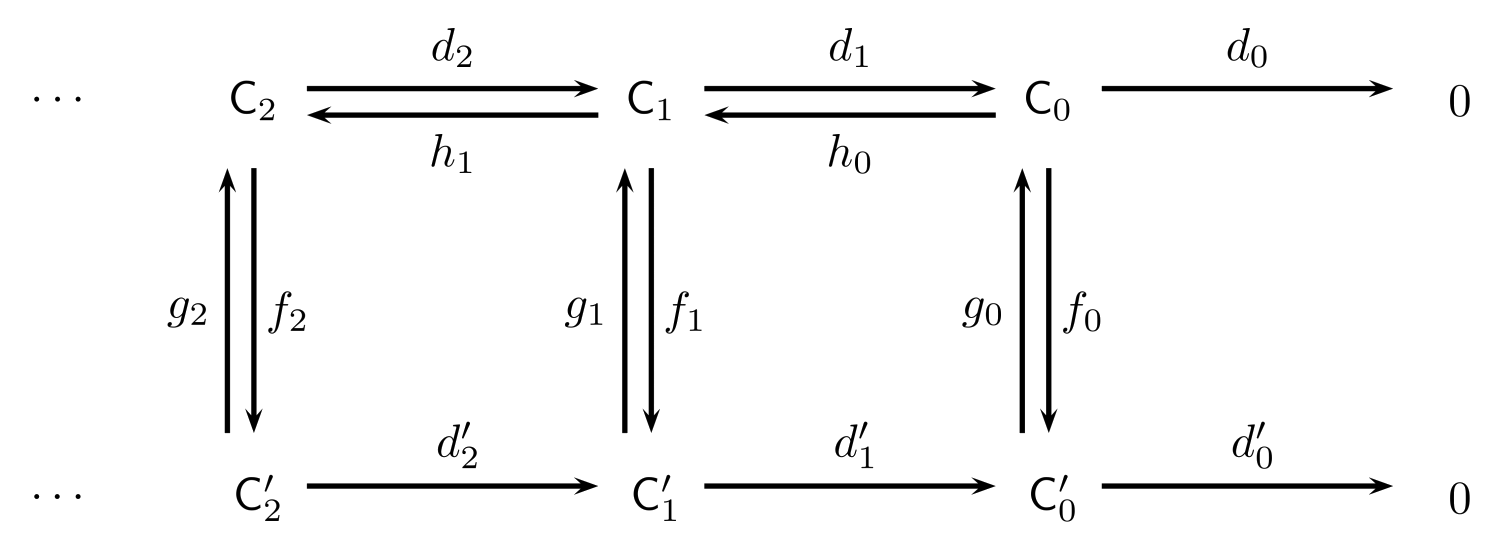
\[\begin{align*} h &= i_S \circ (j_P \circ \partial \circ i_S)^{-1} \circ j_P \\ f &= j_C \circ (1 - \partial \circ h) \\ g &= (1 - h \circ \partial) \circ i_C \\ d &= f \circ \partial \circ i_C \end{align*}\]
There are 6 elementary operations to transform an HDVF (and its reduction)
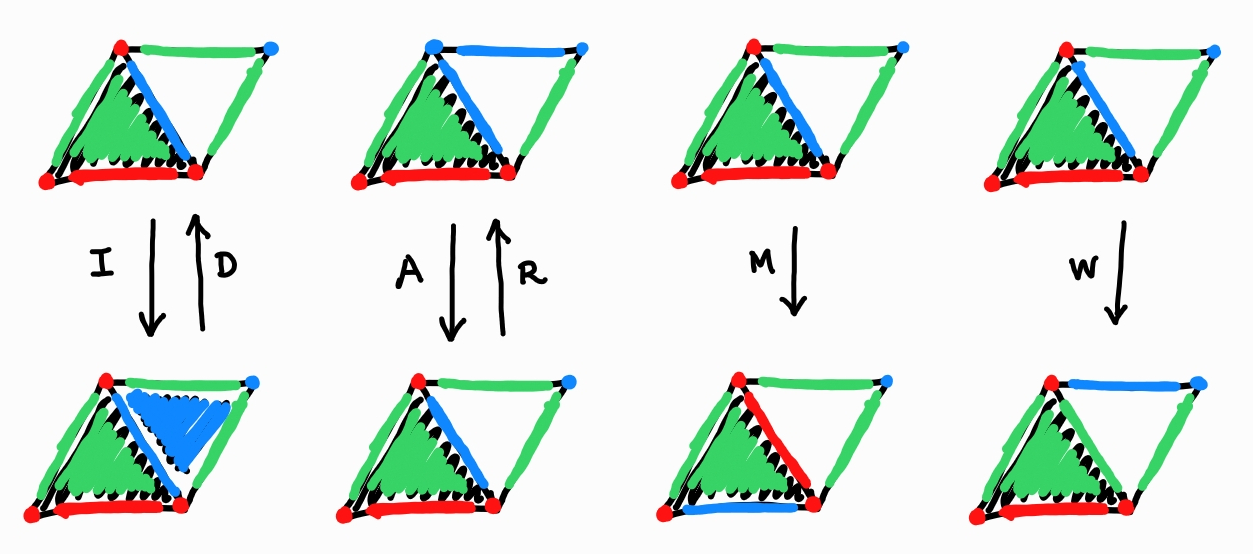
How to make an HDVF?
- Look for a non-zero entry in the matrix of \(d\)
- Change its pair of simplices with \(\mathtt{A}\)
- No need to check invertibility of submatrix
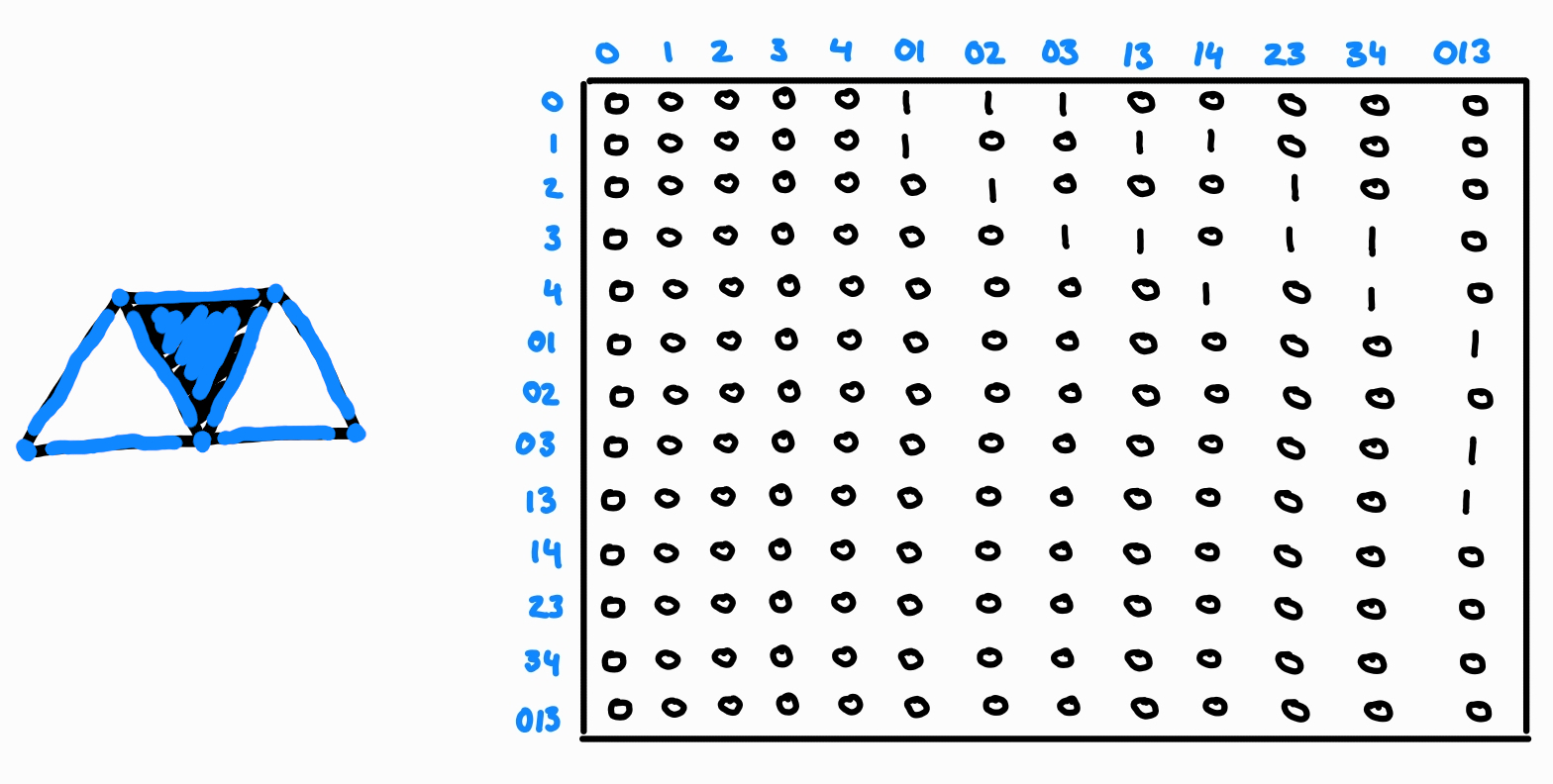
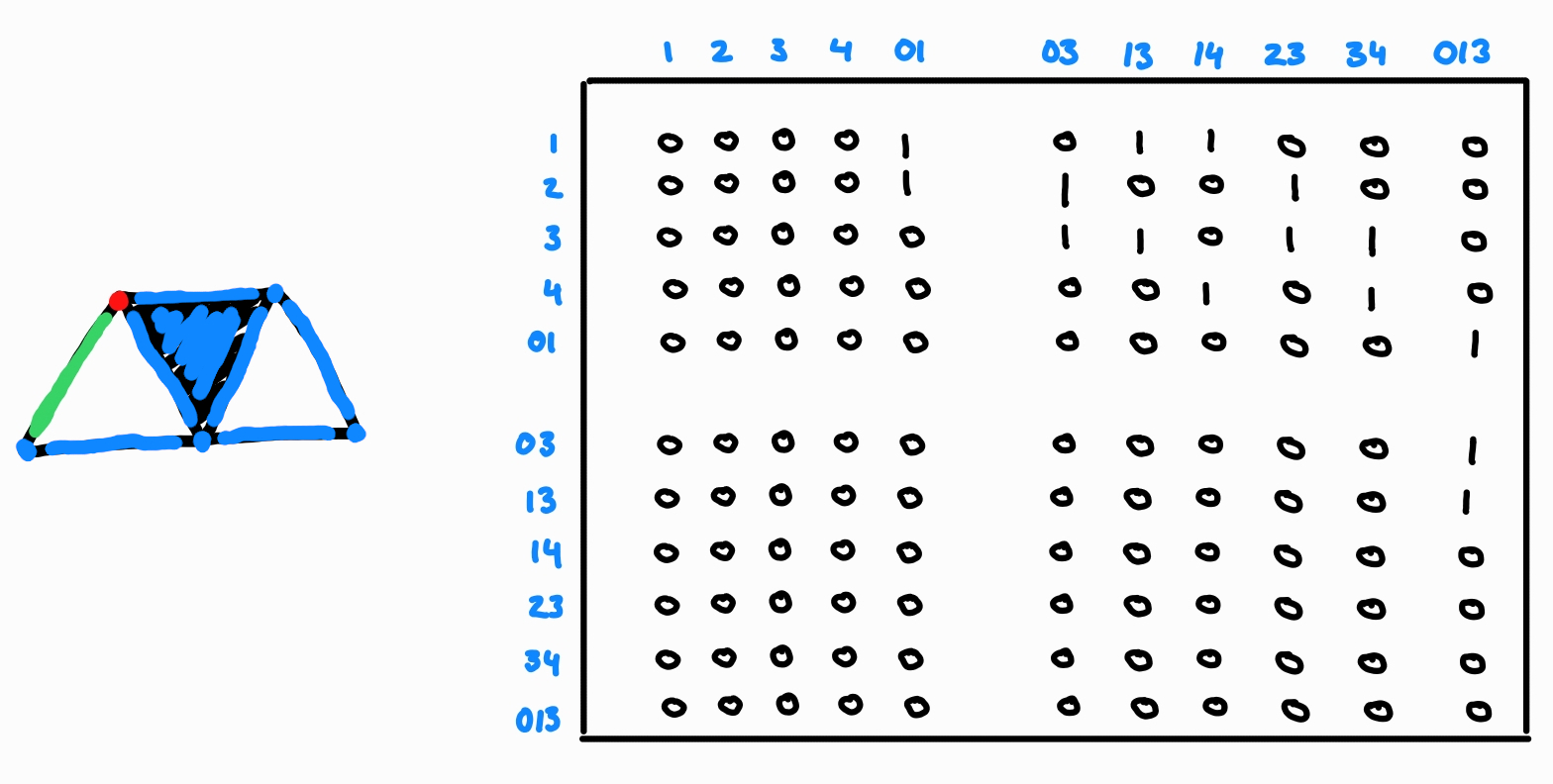
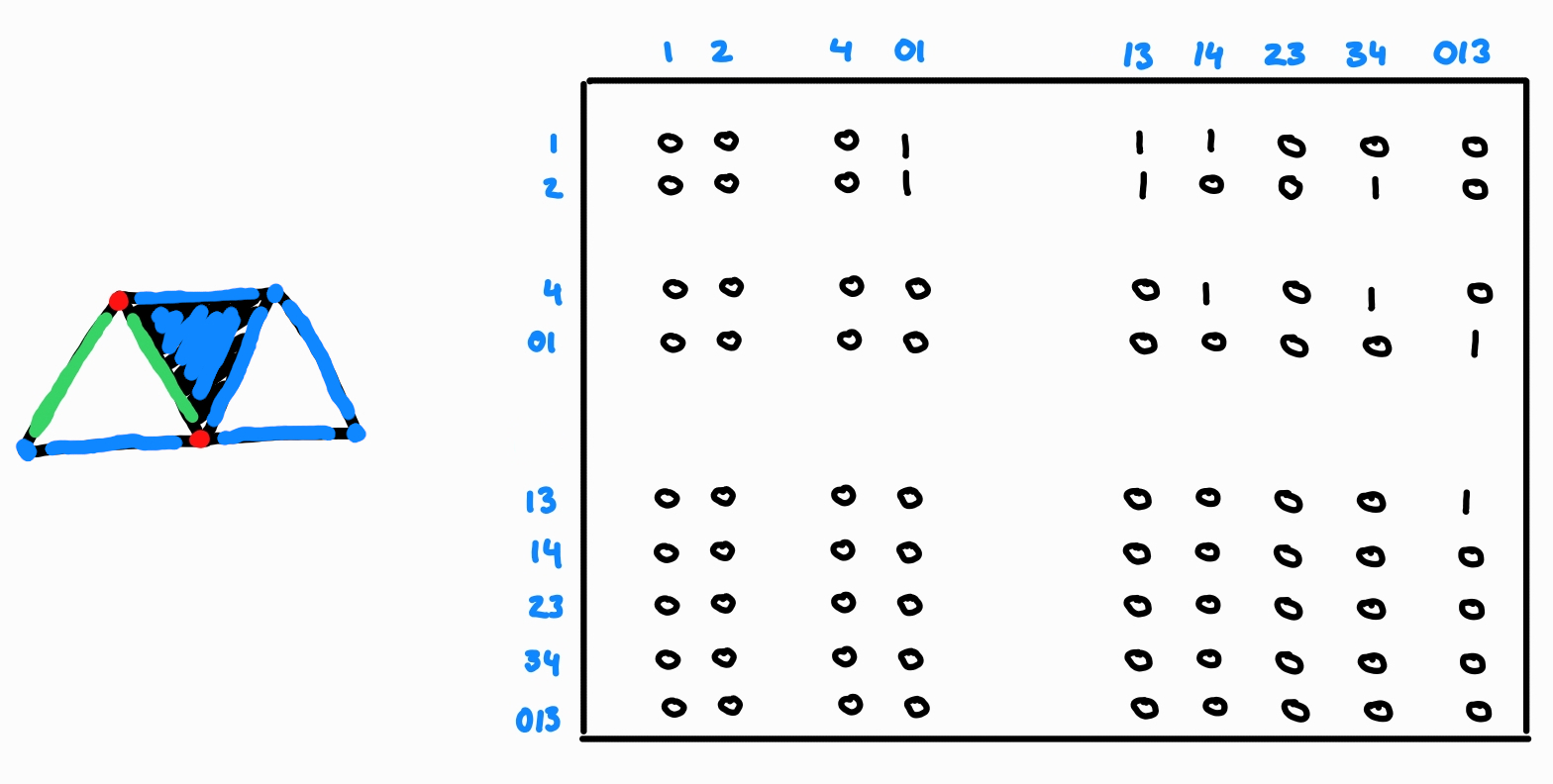
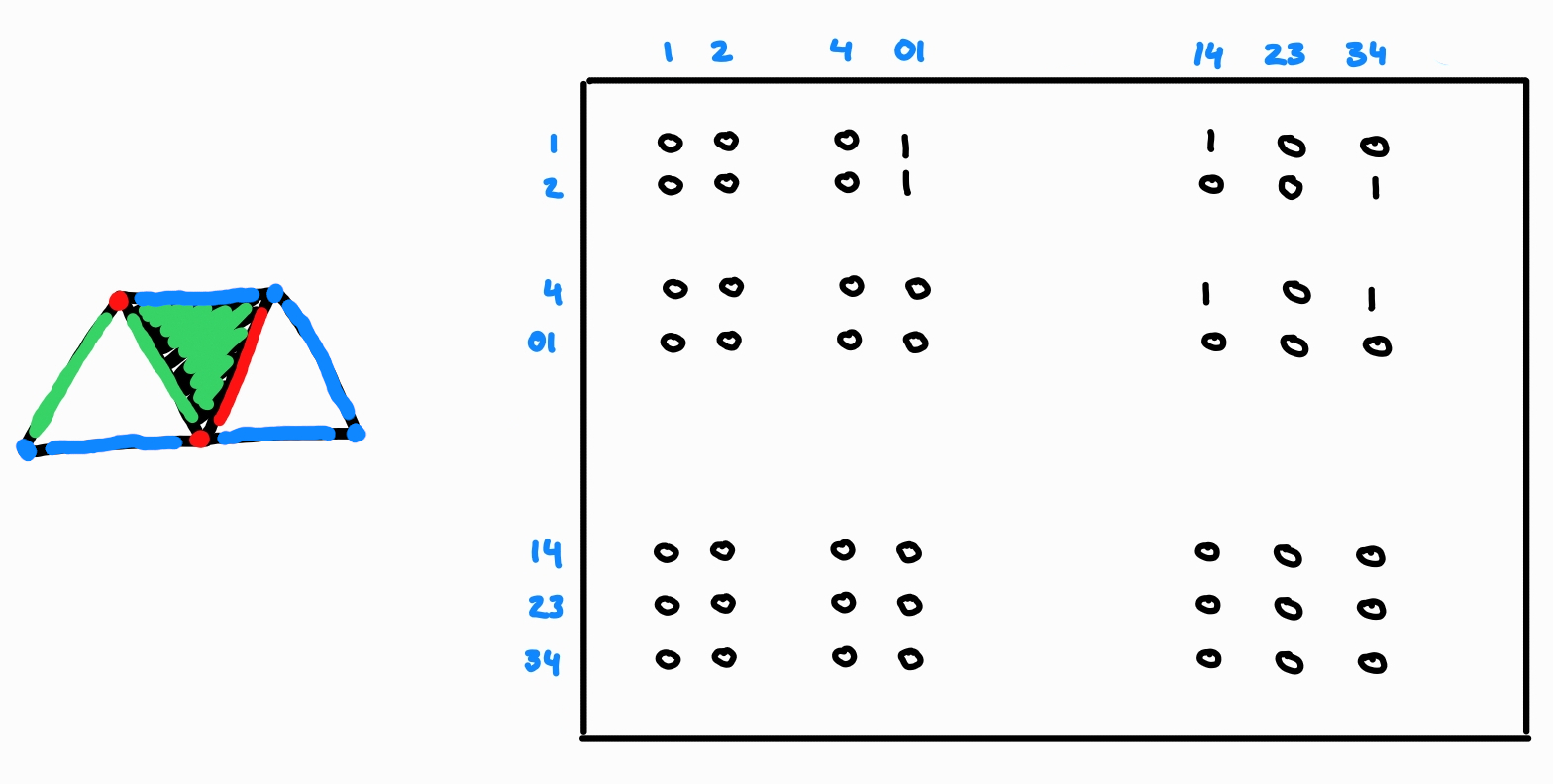
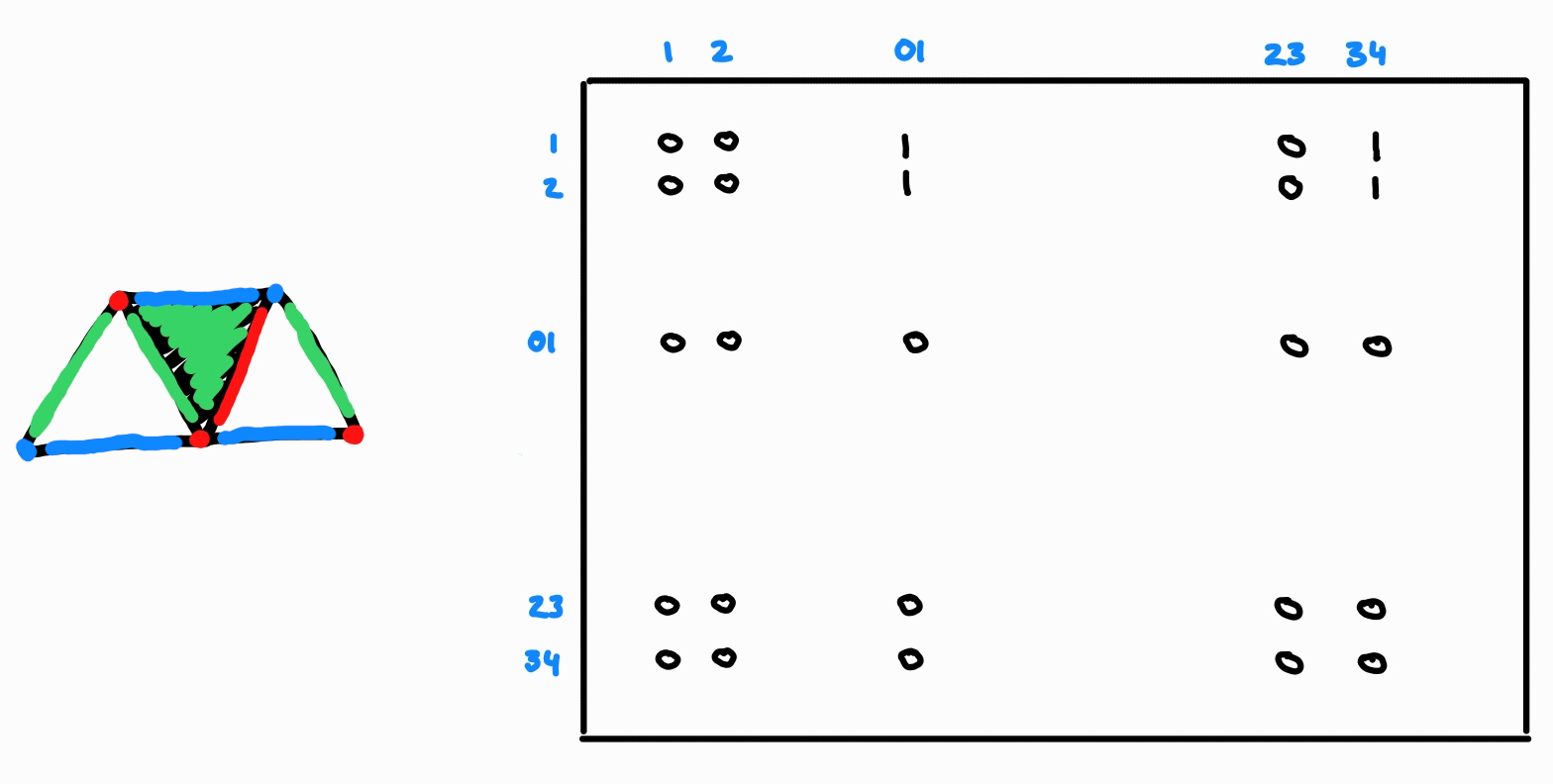
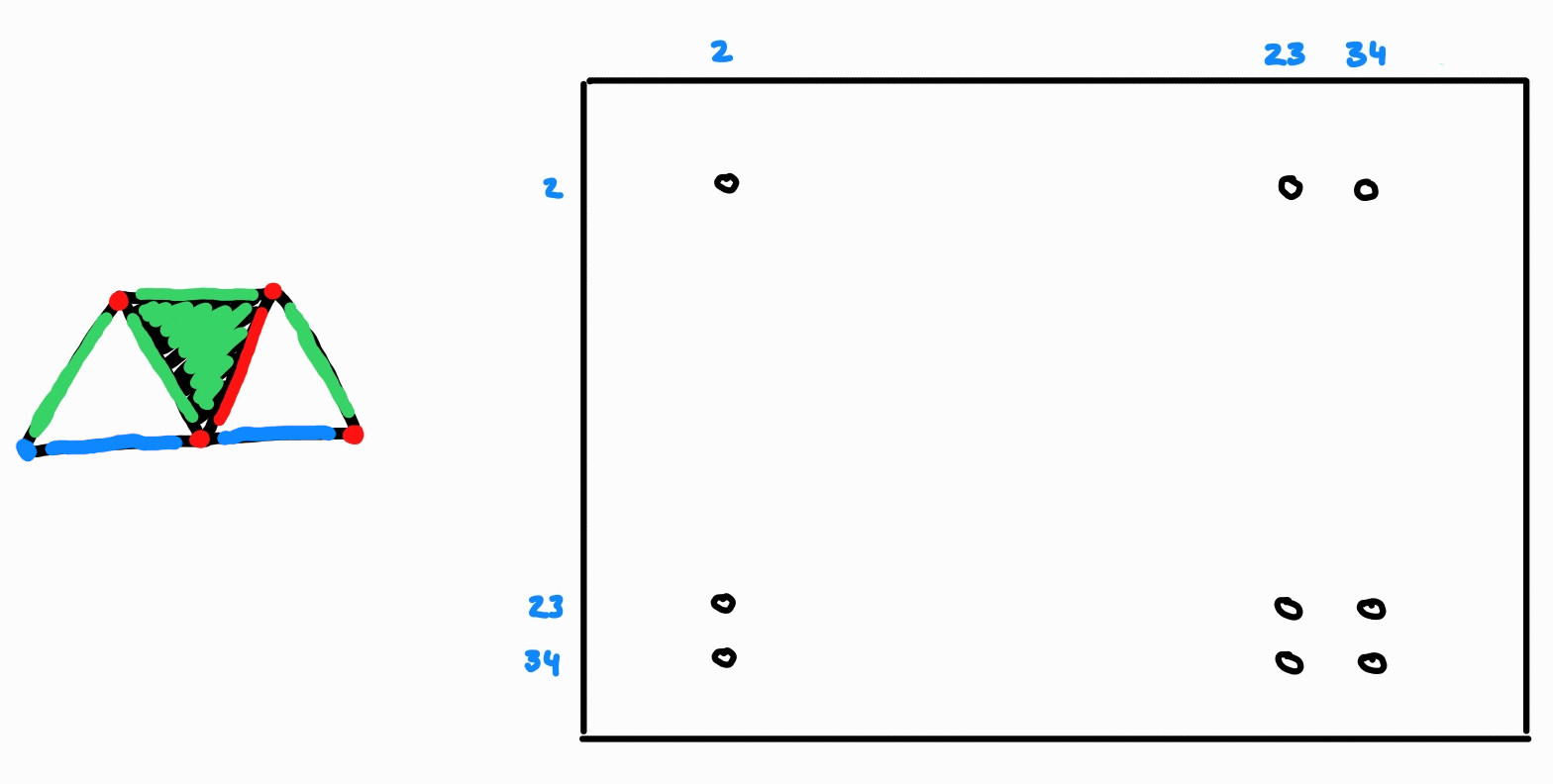
An HDVF is perfect if \(d = 0\) (we can't add more red-green simplices)
- \(\{[g(\gamma)] \mid \gamma \in C\}\) is a basis of \(H(K)\)
- \(f(x) = 0\) if and only if \(x\) is a boundary
- \( x \sim y \iff f(x) = f(y)\)
- \(x \sim g \circ f(x)\)
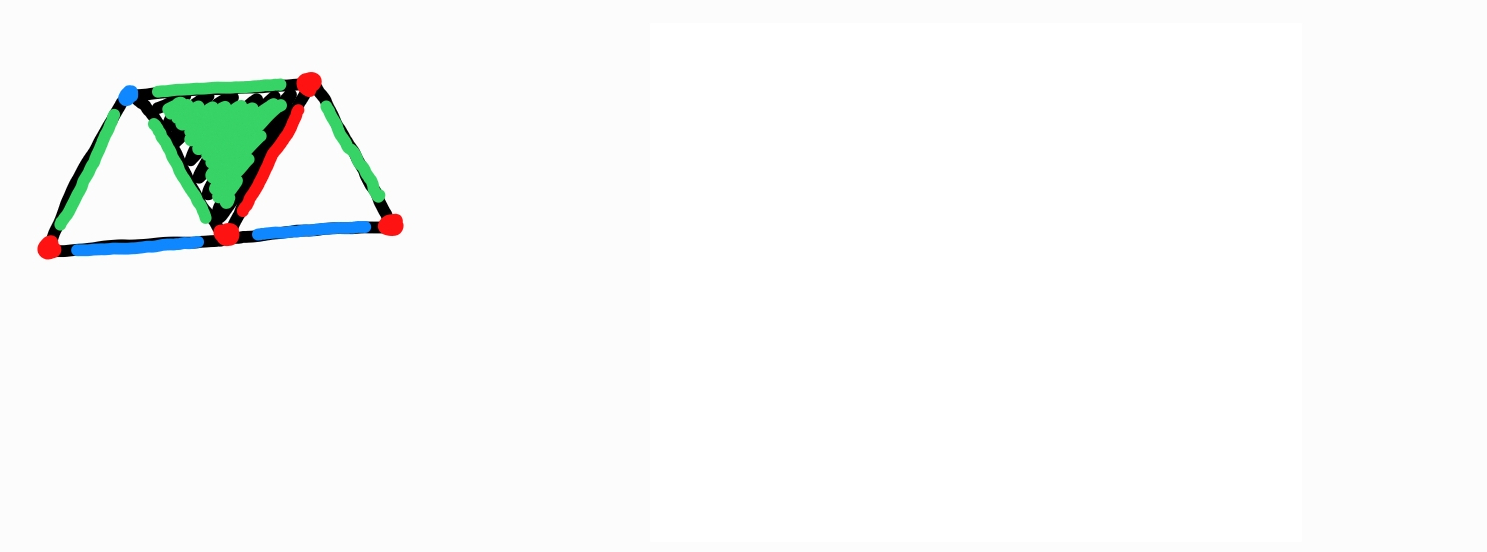
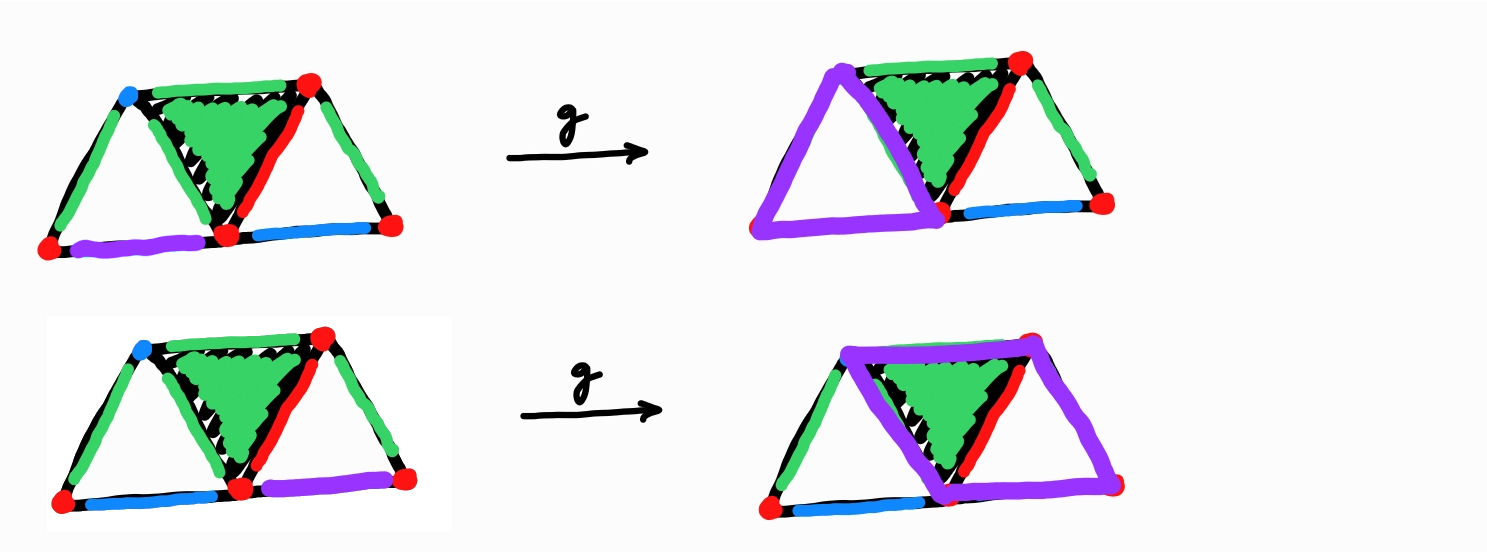
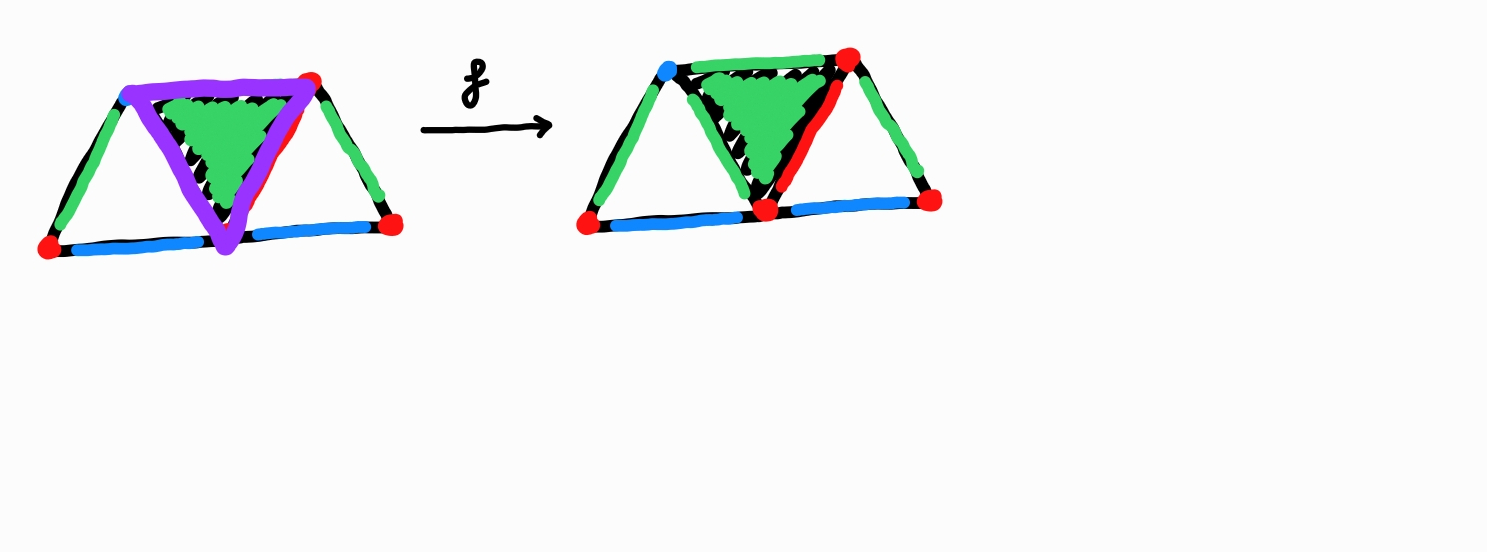
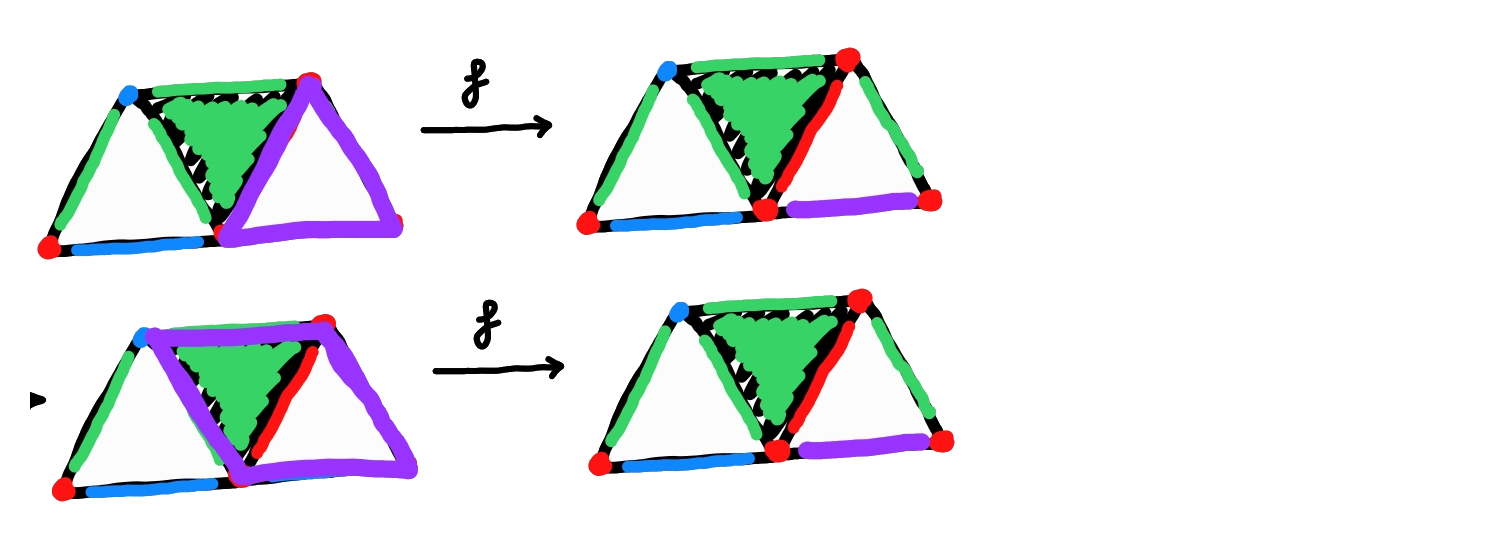
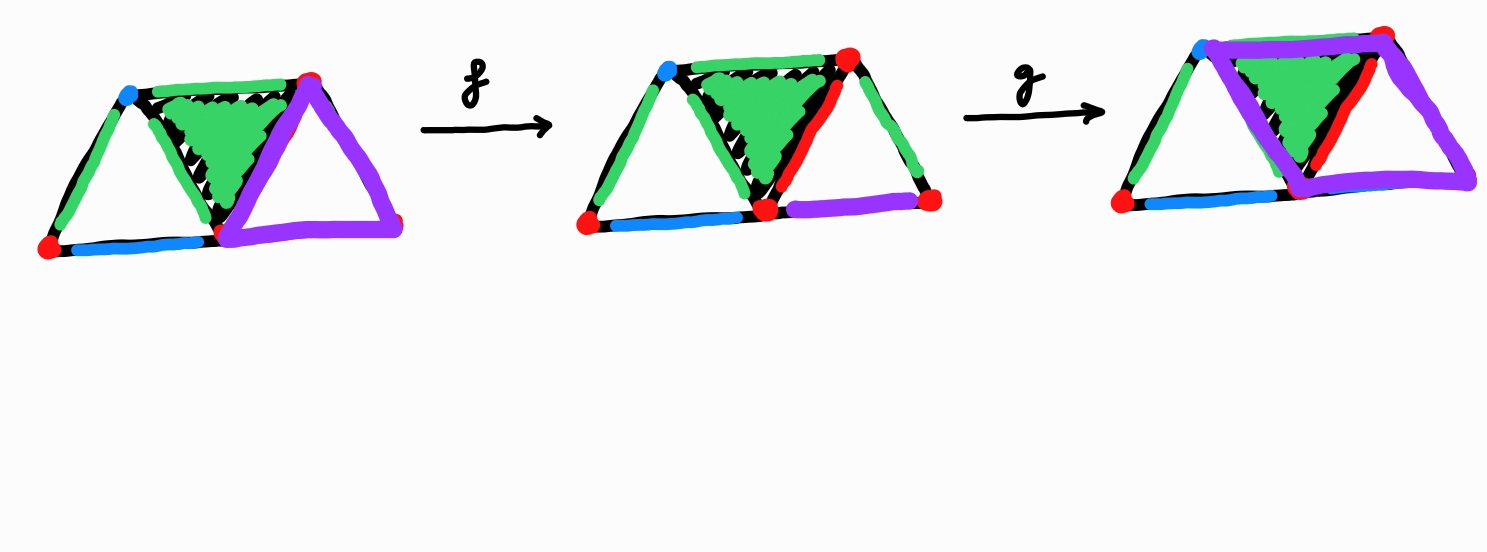
Simplicial complex + perfect HDVF = homology group
Zigzag Persistent Homology
(with Representative Interval Decompositions)
Zigzag filtration
Sequence of simplicial complexes, add or remove one simplex

Representative basis
Set of cycles whose homology classes form a basis for \(H(K)\)
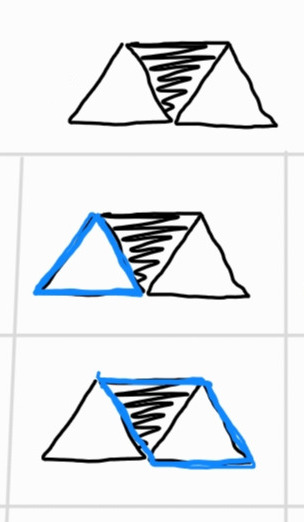
Representative Interval Module
Sequence of cycles where inclusions send non-empty cycles to the same homology class
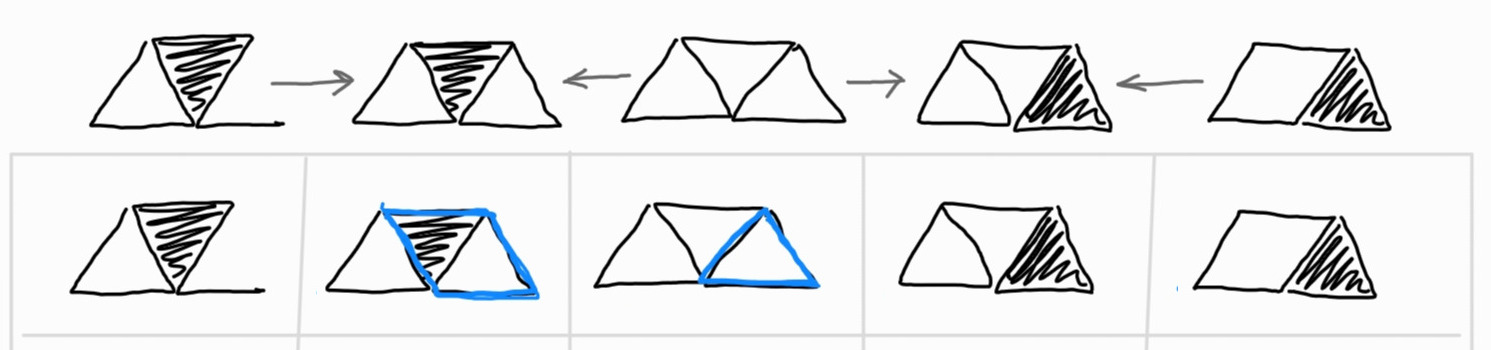
Representative Interval Decomposition
Grid of cycles where
- each column is a representative basis
- each row is a representative interval module
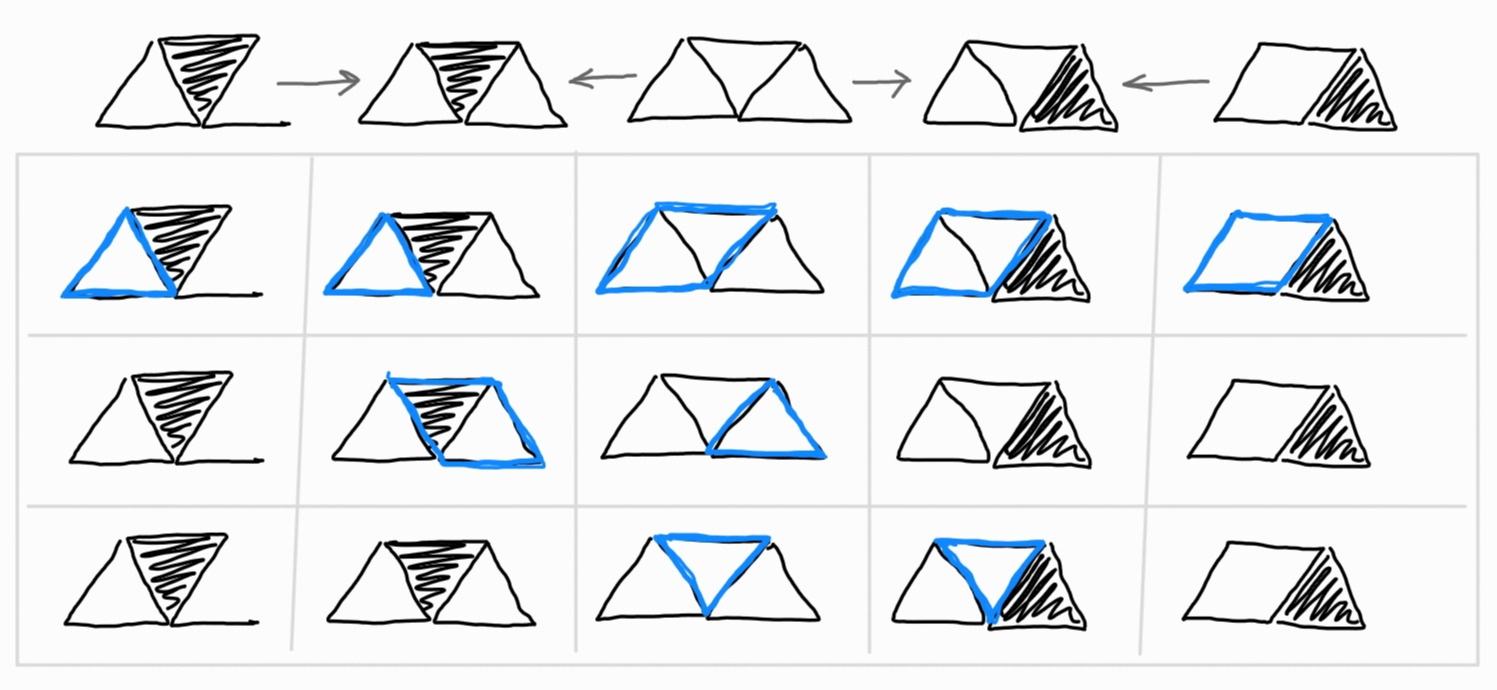
Representative Interval Decomposition
Theorem The intervals of non-empty cycles are the persistence intervals ✅
Zigzag filtration + RID = persistence intervals
Computing Zigzag Persistent Homology
(spoiler: it is not efficient)
Problem: extend a RID after appending a new simplicial complex
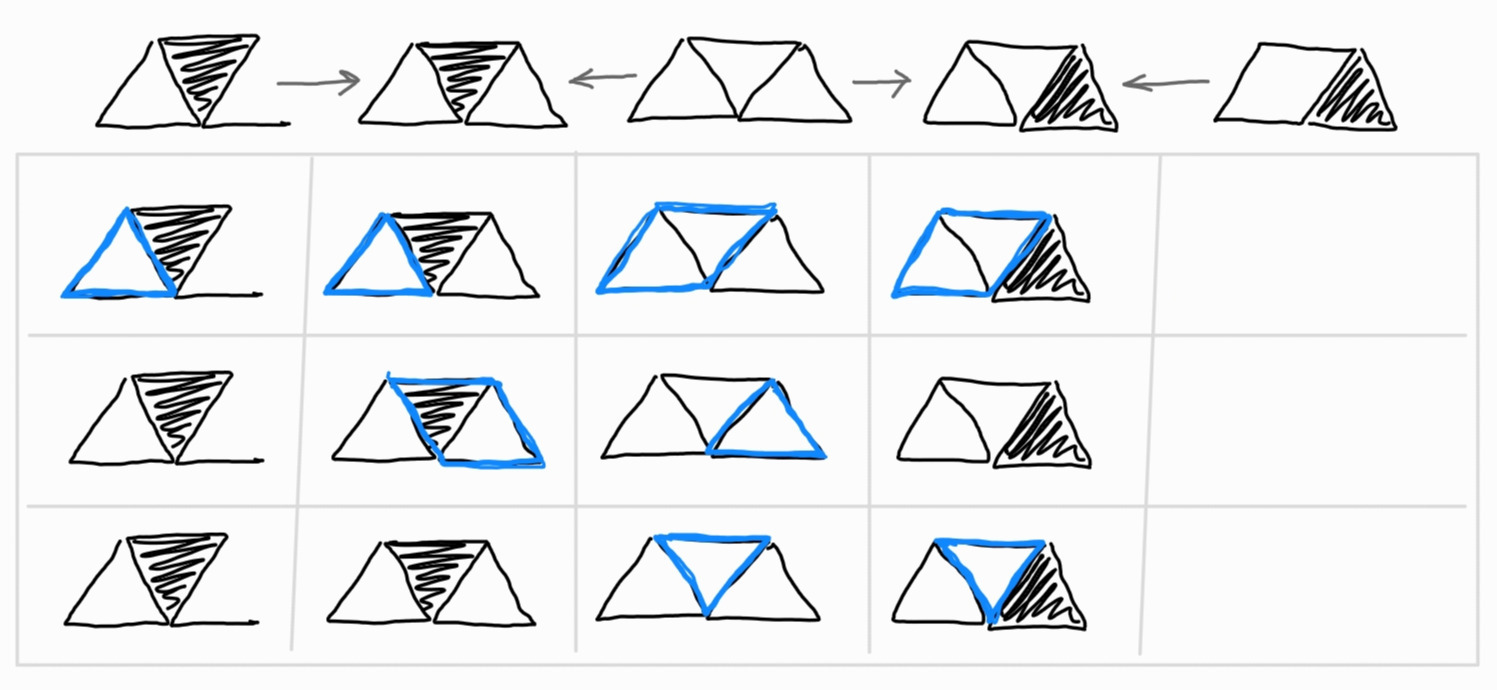
New representative basis
There are four cases:
- add or remove a simplex
- which adds or removes a hole
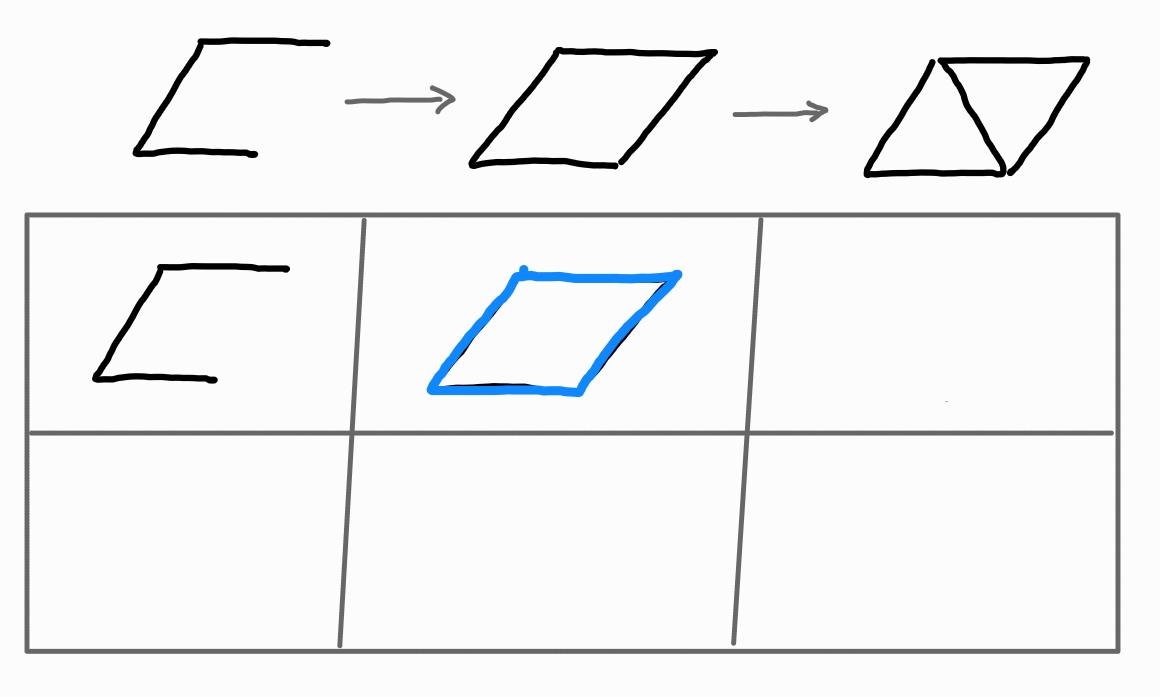
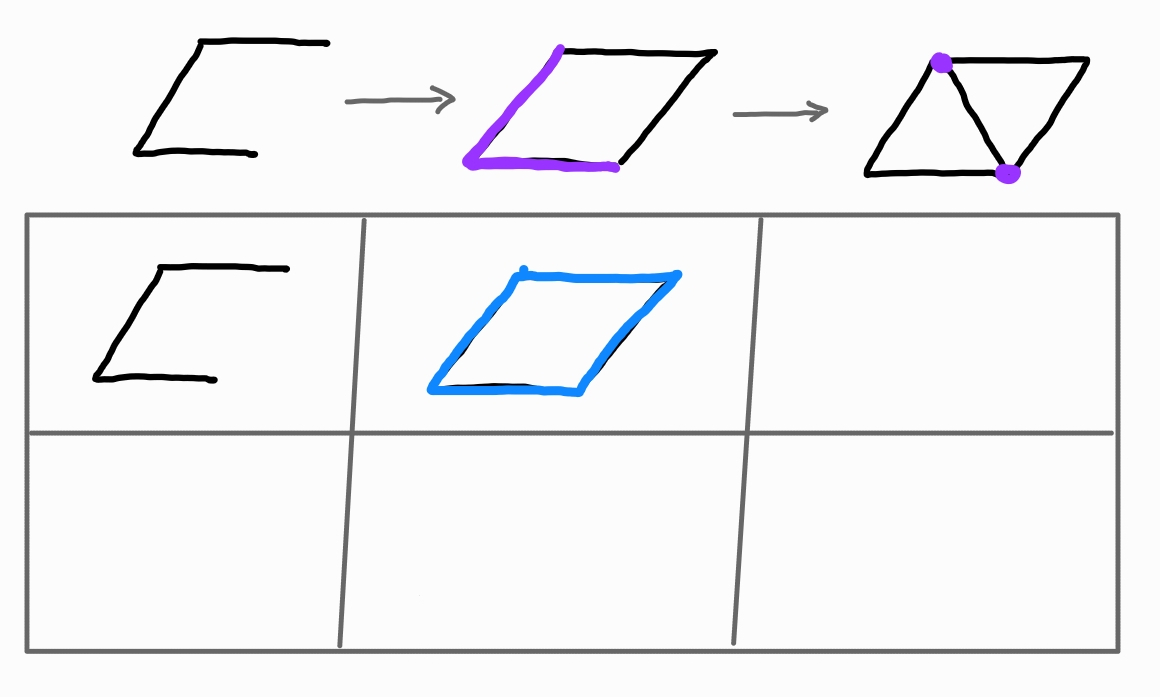
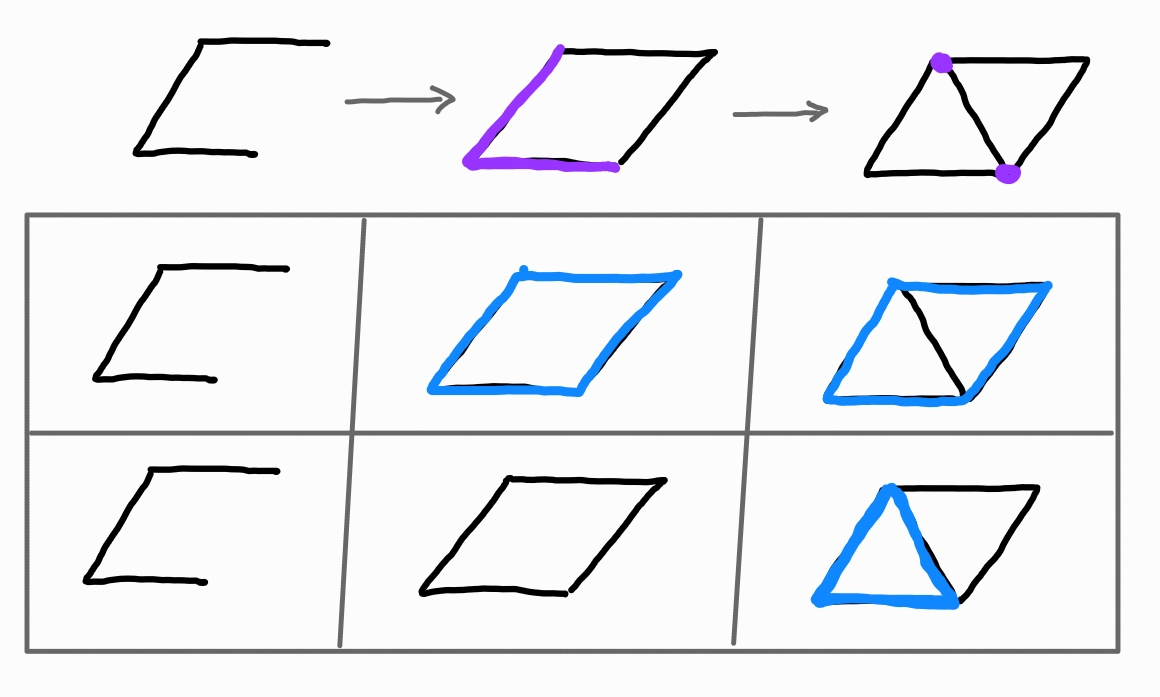
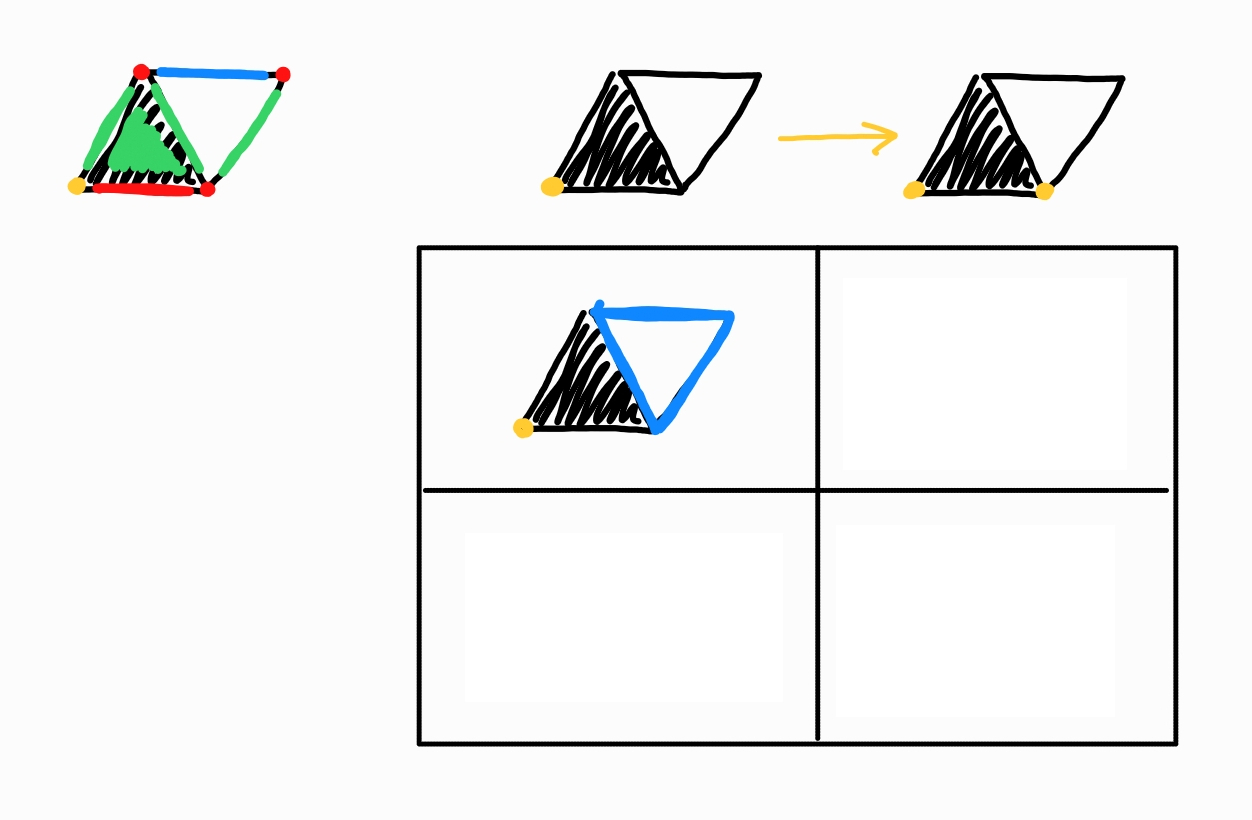
(A.1) Add a simplex, add a hole
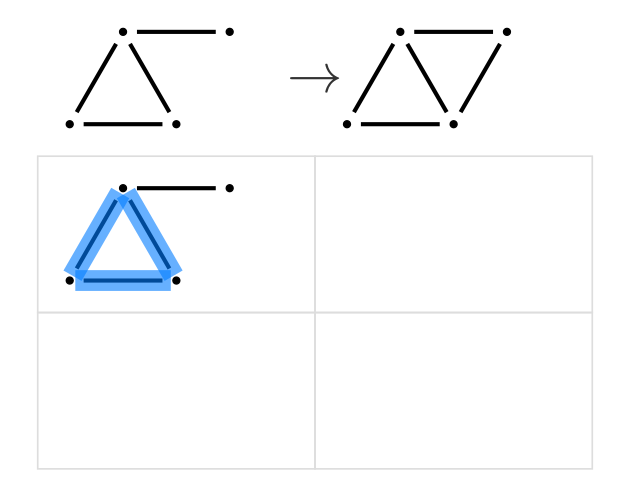
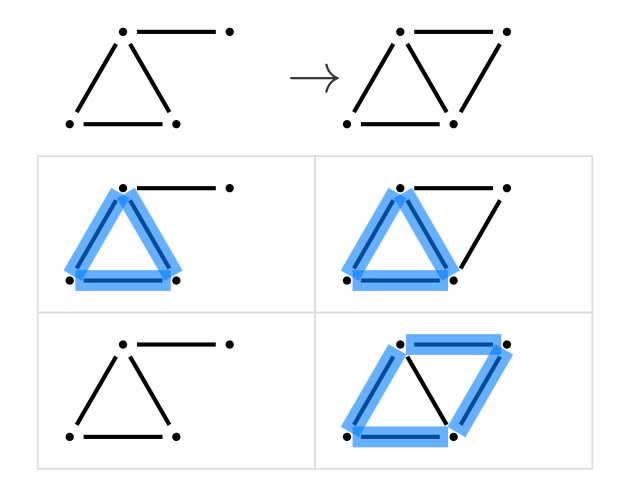
Lemma If \(\partial(\sigma)\) is a boundary, then add a cycle \(x\) containing \(\sigma\)
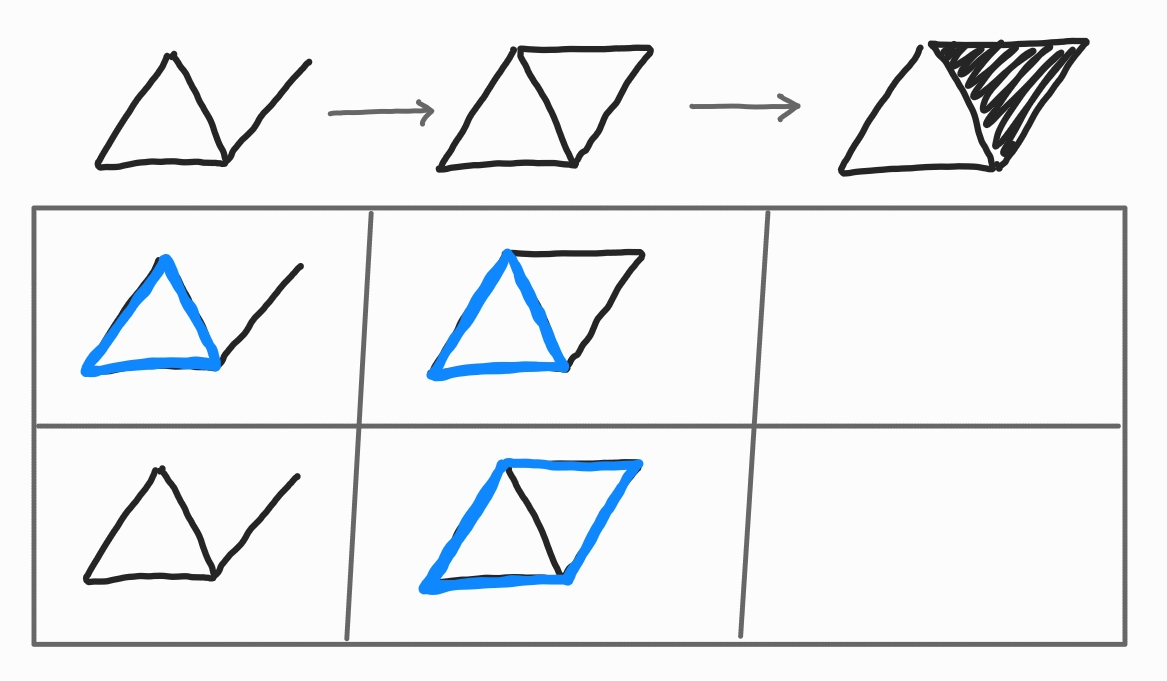
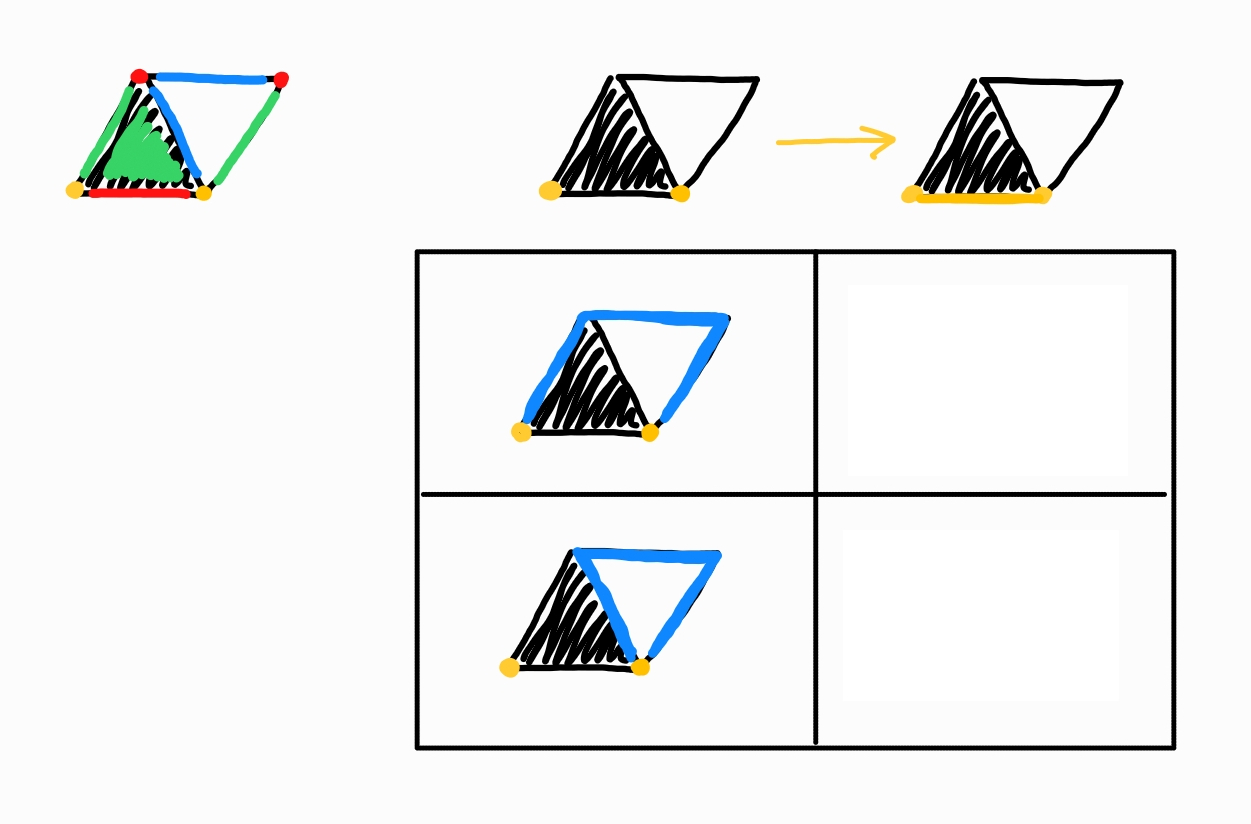
(A.2) Add a simplex, remove a hole
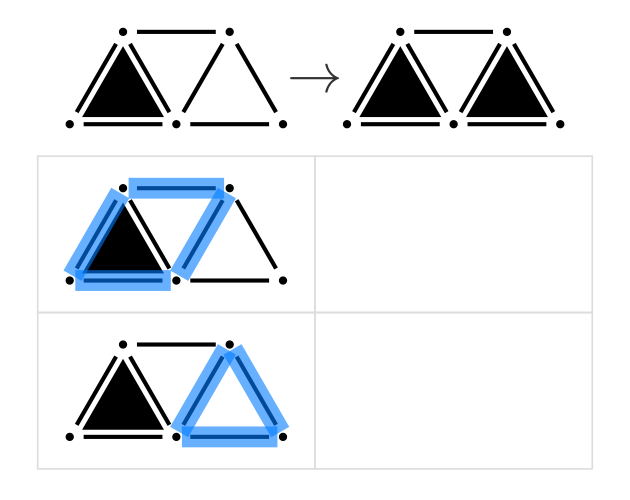
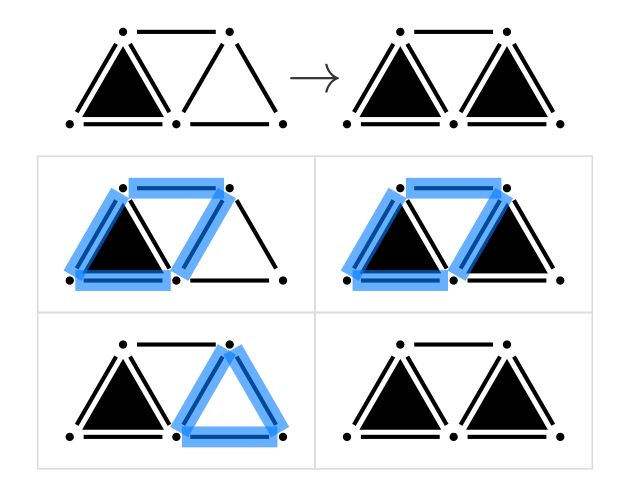
Lemma If \(\partial(\sigma) \sim\) some cycle \(x\) of the basis, then remove it
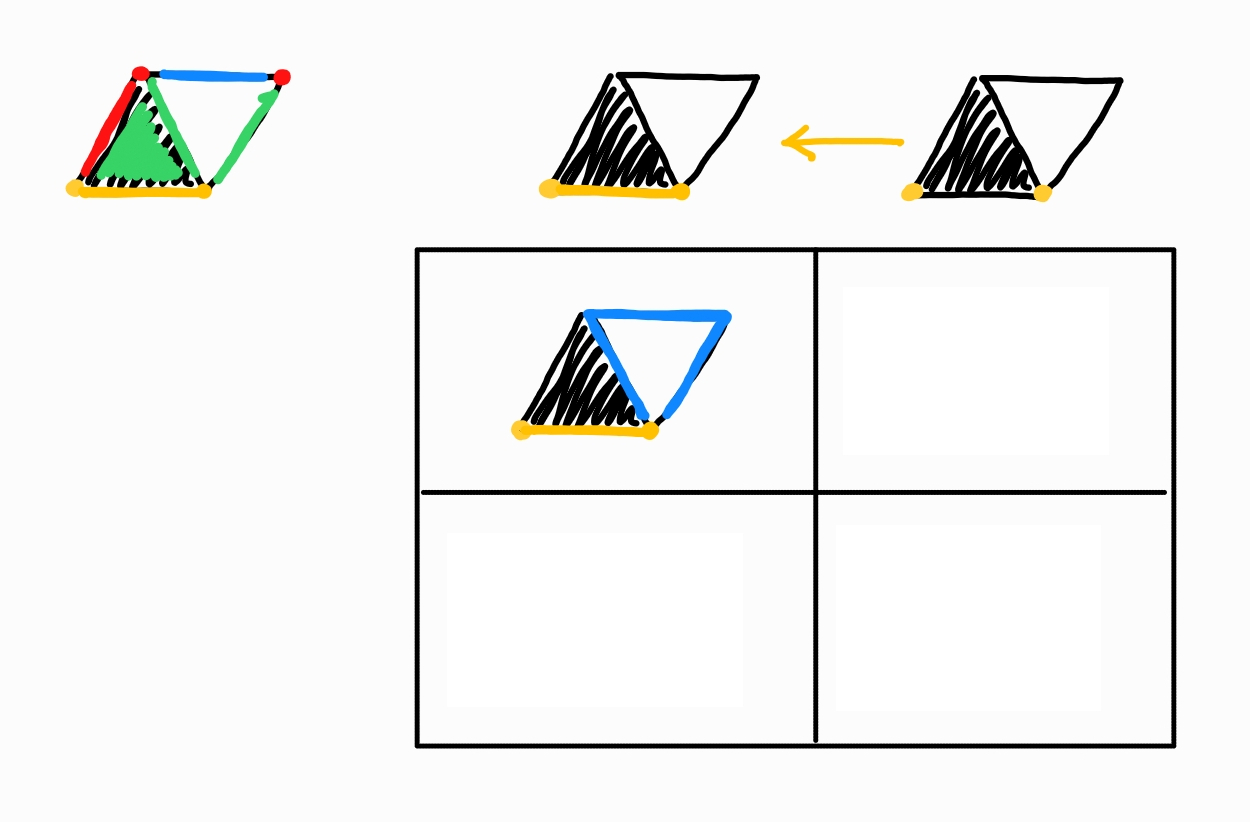
(B.1) Remove a simplex, add a hole
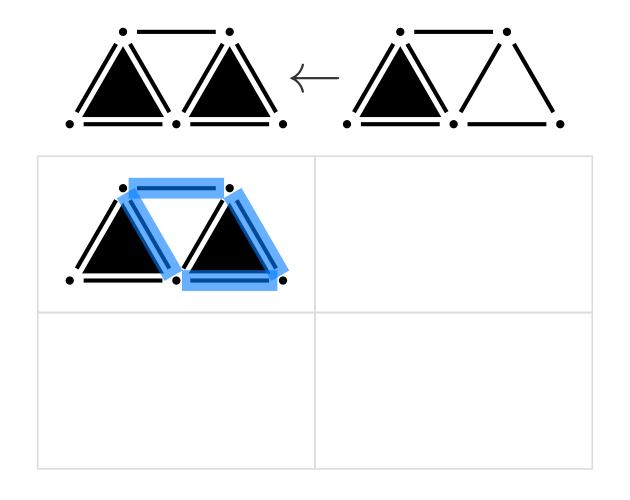
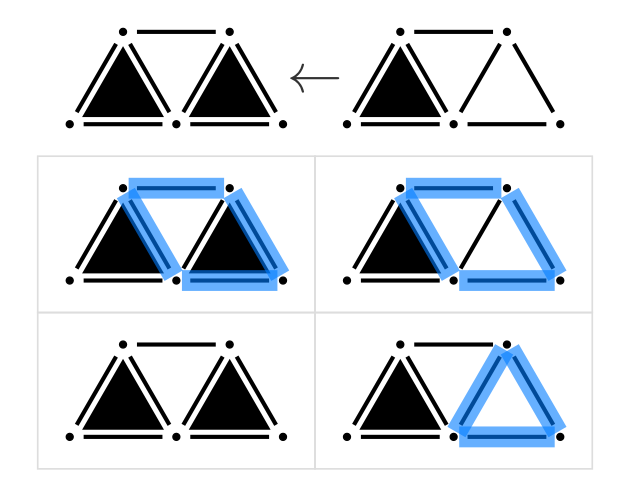
Lemma If \(\sigma\) does not belong to any cycle of the basis, then add \(\partial(\sigma)\)
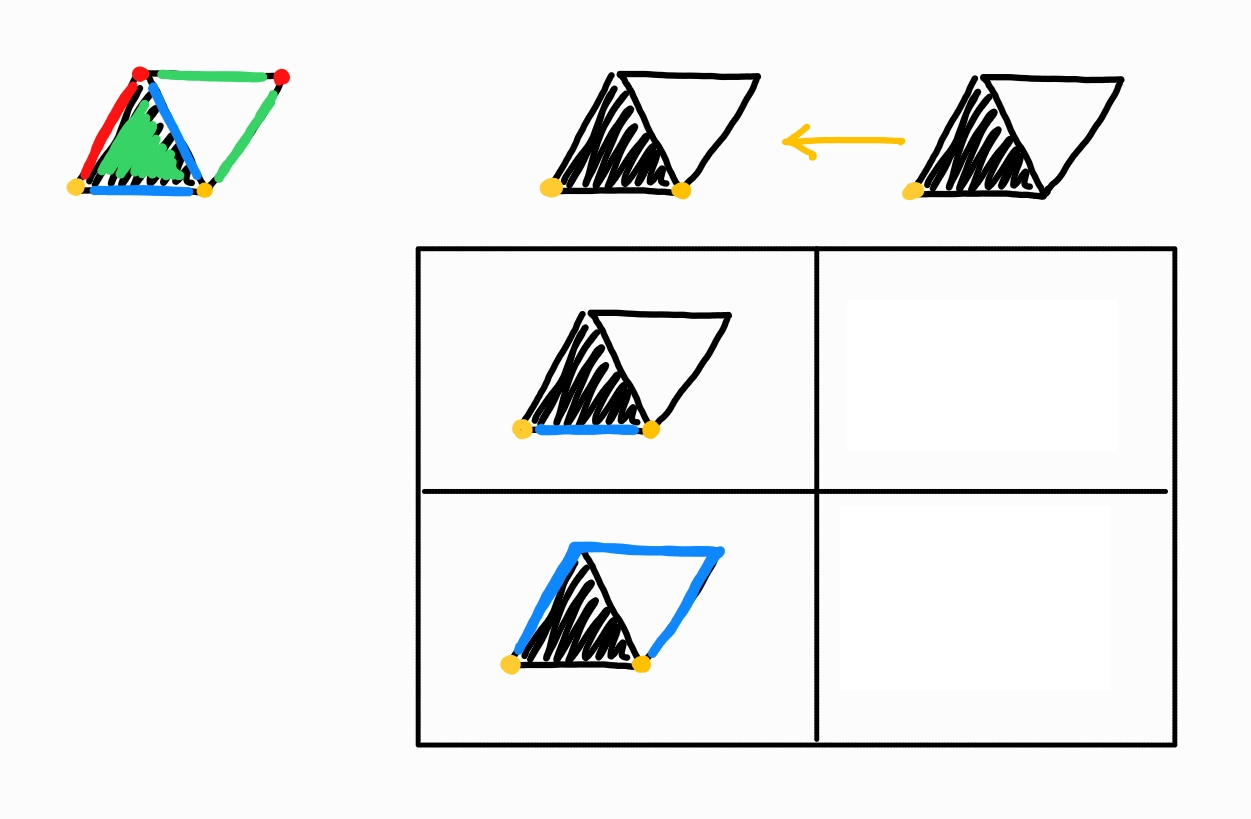
(B.2) Remove a simplex, remove a hole
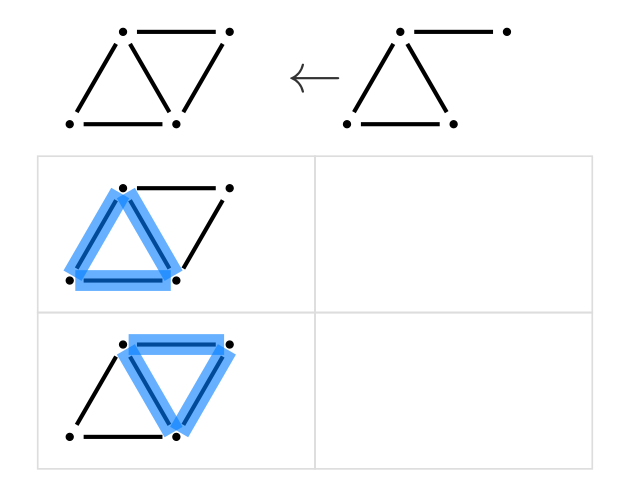
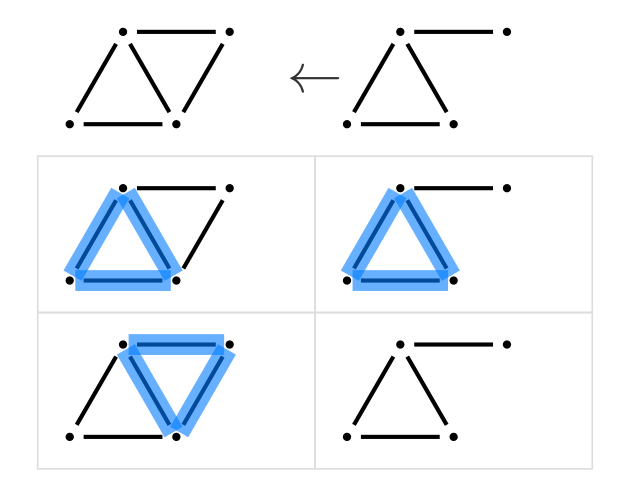
Lemma If \(\sigma\) belongs to exactly one cycle of the basis, then remove it
Linear combinations in a RID
What if
- \(\partial(\sigma) \sim x + x'\) in case A.2?
- \(\sigma\) belongs to two cycles in case B.2?
We need to change the representative basis ⟶ RID
Lemma If \(\mathbf{x} \leq \mathbf{y}\) then we can replace \(\mathbf{y} \gets \mathbf{x} + \mathbf{y}\) to change the representative basis
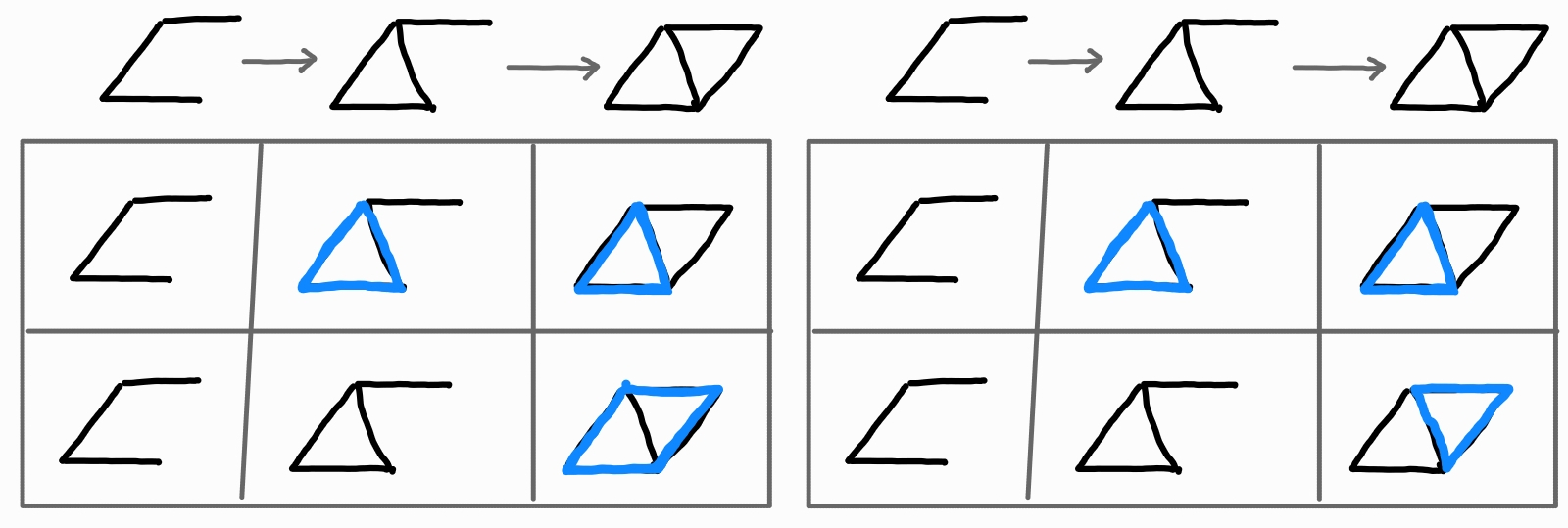
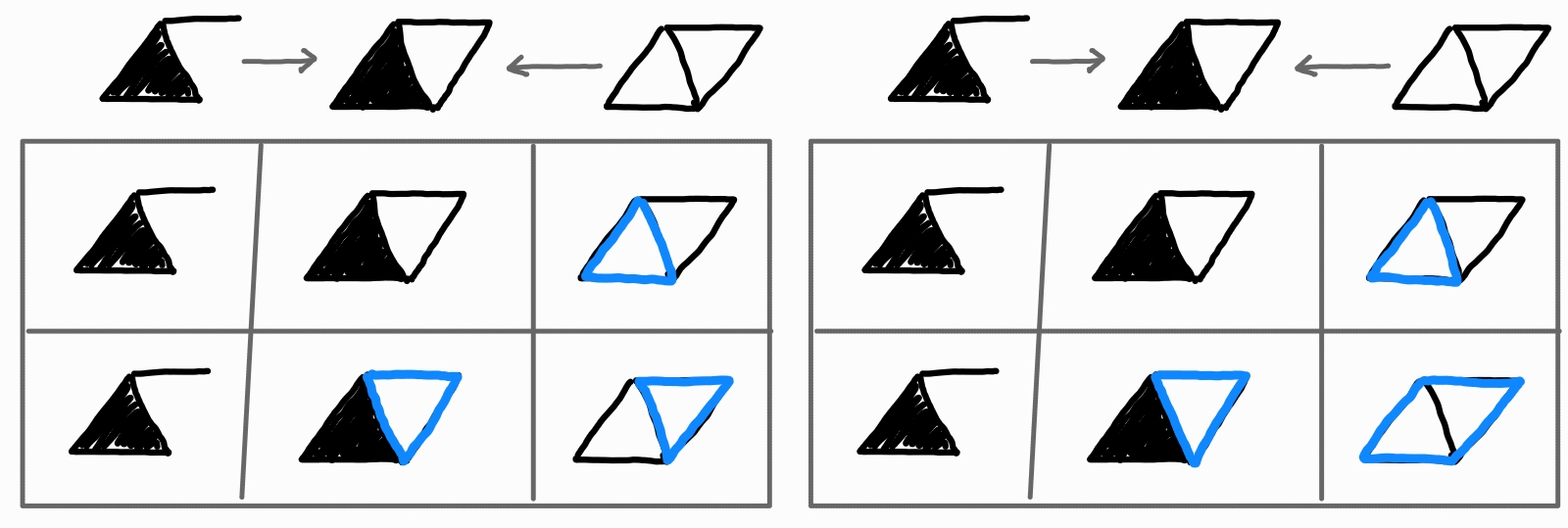
\[\mathbf{x} \leq \mathbf{y} \iff \begin{cases} \left( b(\mathbf{x}) \leq b(\mathbf{y}) \text{ and } \mathbf{y} \text{ is forward} \right) & \text{or} \\ \left( b(\mathbf{y}) \leq b(\mathbf{x}) \text{ and } \mathbf{x} \text{ is backward} \right) \end{cases}\]
Abstract algorithm
- initializeModules() (first column)
-
for each step:
-
if add simplex \(\sigma\):
- \(x = \sum \lambda_{k} \cdot x^{(k)} \gets\) decompose(\(\partial(\sigma))\)
- if \(x = 0\): case A.1 (add a hole)
- else: case A.2 (remove a hole)
-
if remove simplex \(\sigma\):
- \(x = \sum \lambda_{k} \cdot x^{(k)} \gets\) cyclesWith(\(\sigma)\)
- if \(x = 0\): case B.1 (add a hole)
- else: case B.2 (remove a hole)
-
if add simplex \(\sigma\):
Case A.1
- placeholderA1()
- \(y \gets\) newCycleForward() (the new cycle)
- extend all rows, add row \((0, ..., 0, y)\)
Case A.2
- \(\mathbf{x}^{(i)} \gets\) maximum RIM in \(x\)
- replace \(\mathbf{x}^{(i)}\) by \(\sum \lambda_{k} \cdot \mathbf{x}^{(k)}\) (now \(\partial(\sigma) \sim \mathbf{x}^{(i)}\))
- append 0 to \(\mathbf{x}^{(i)}\), extend other rows
- placeholderA2()
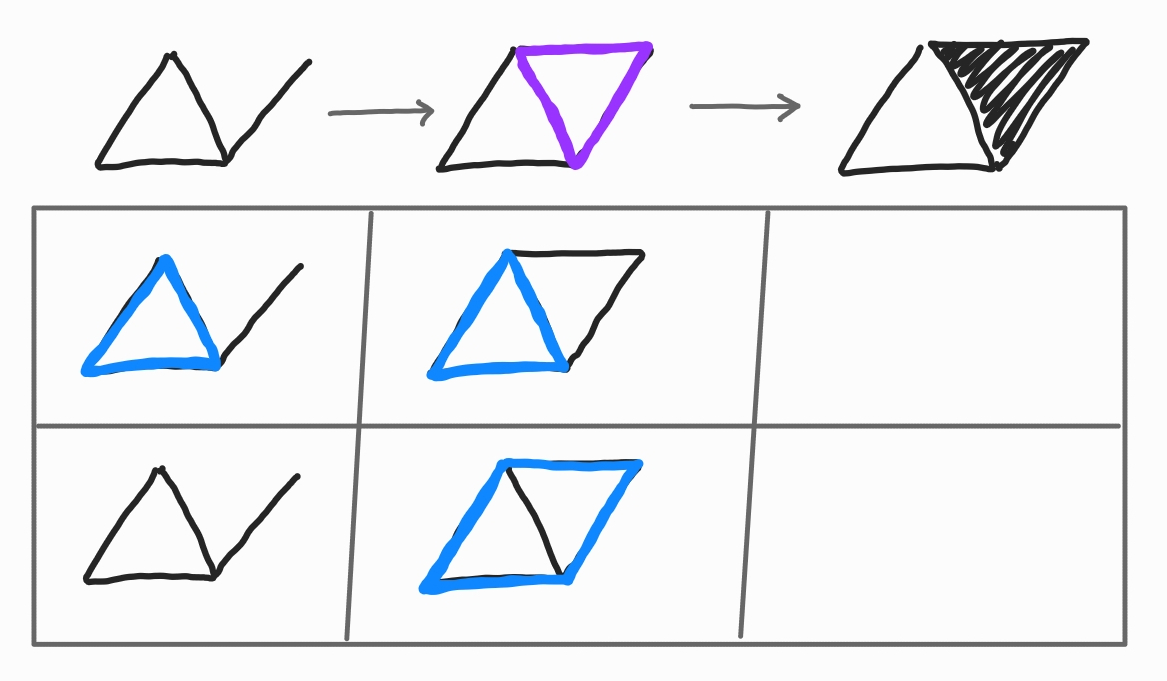
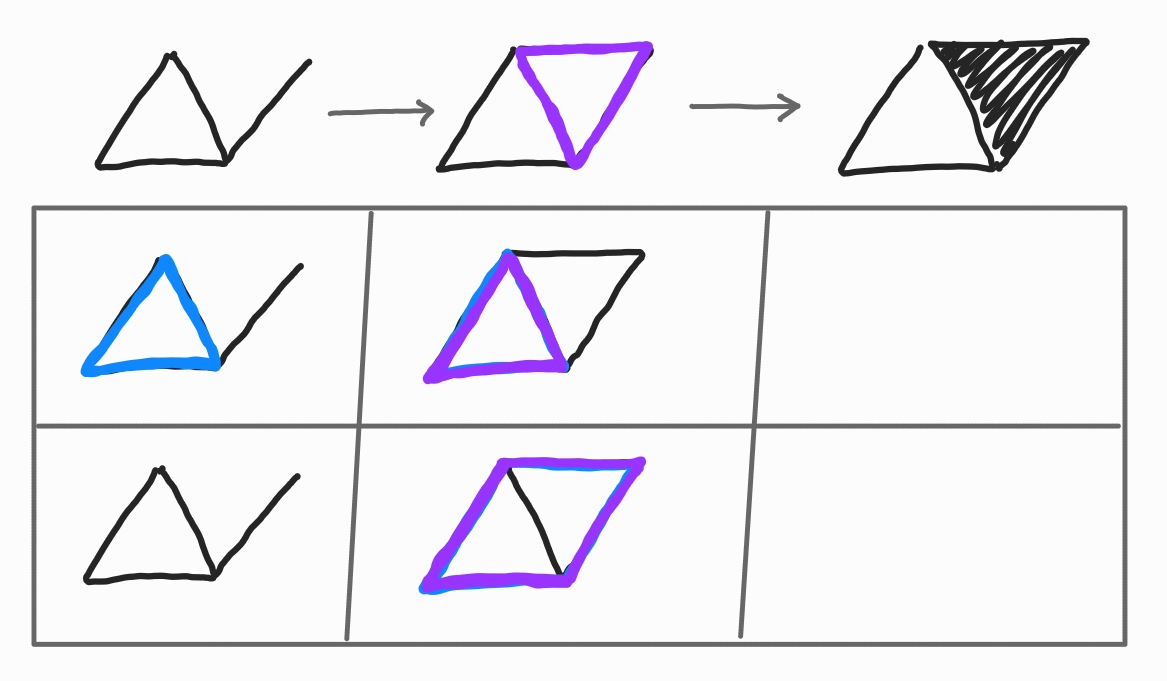
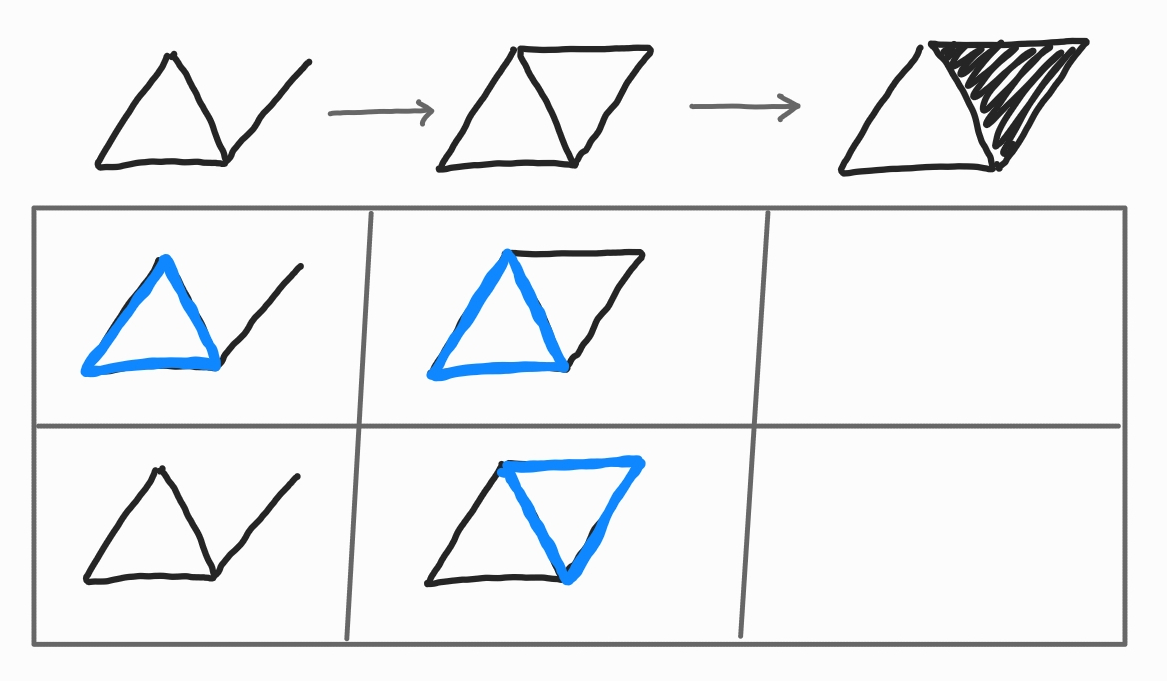
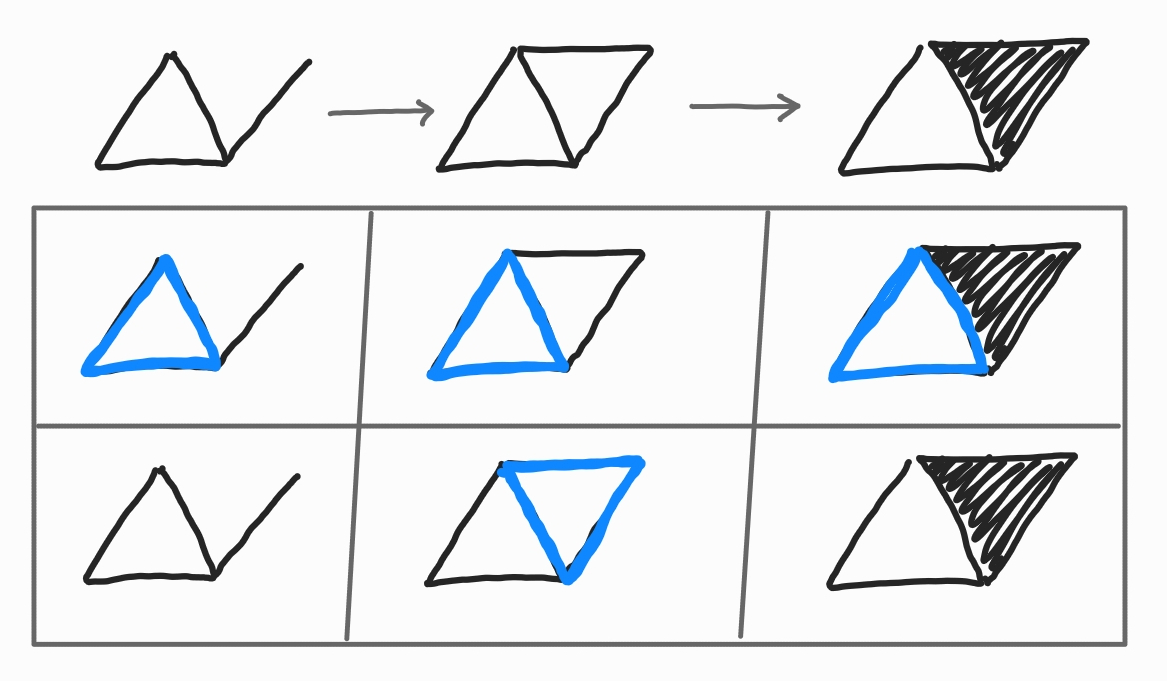
Case B.1
- placeholderB1()
- \(y \gets\) newCycleBackward() (the new cycle)
- extend all rows, add row \((0, ..., 0, y)\)
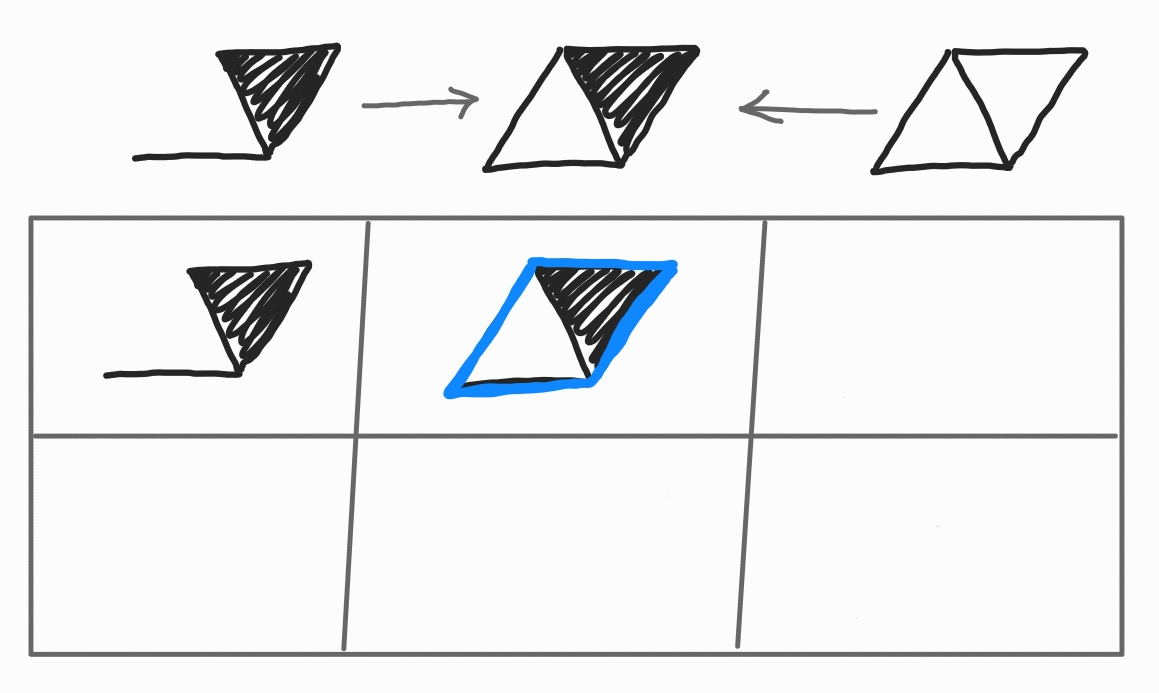
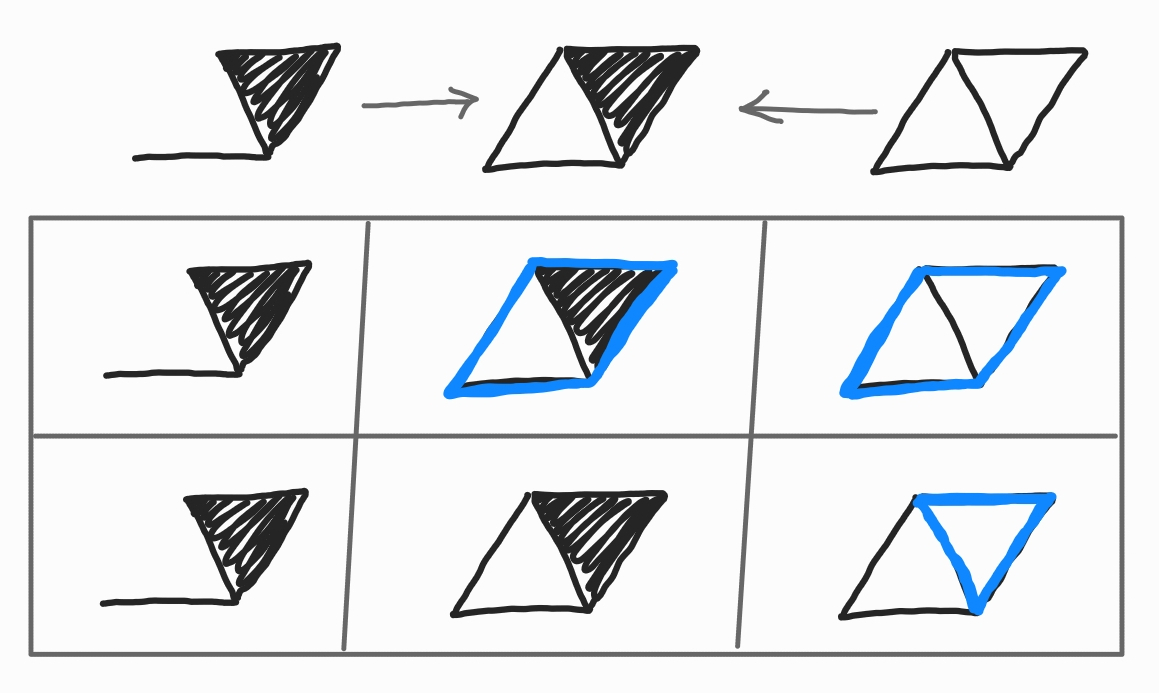
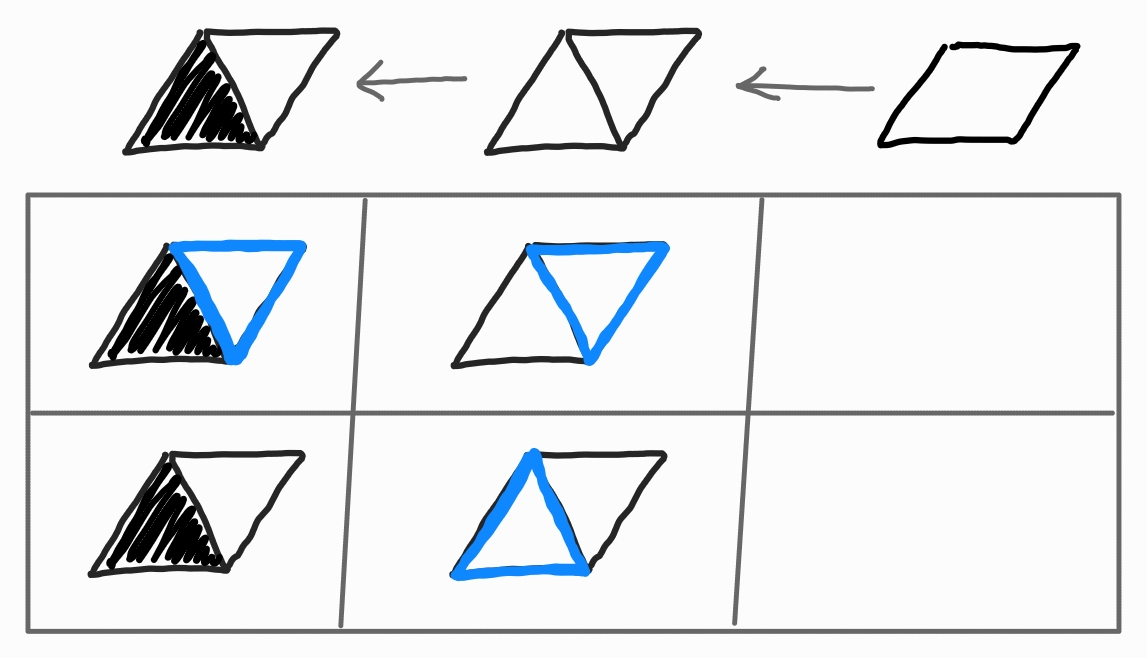
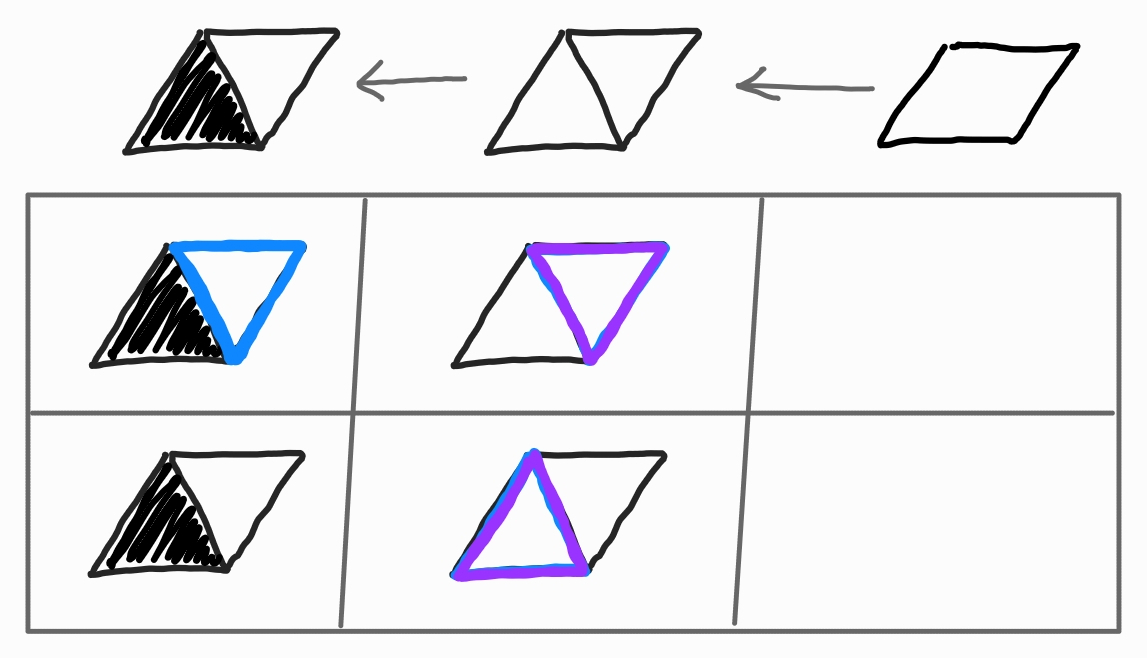
Case B.2
- \(\mathbf{x}^{(i)} \gets\) minimum RIM in \(x\)
- replace \(\mathbf{x}^{(k)}\) by \(\mathbf{x}^{(k)} - \lambda_{k} \cdot \mathbf{x}^{(i)}\) (now \(\sigma\) belongs to a single cycle)
- append 0 to \(\mathbf{x}^{(i)}\), extend other rows
- placeholderB2()
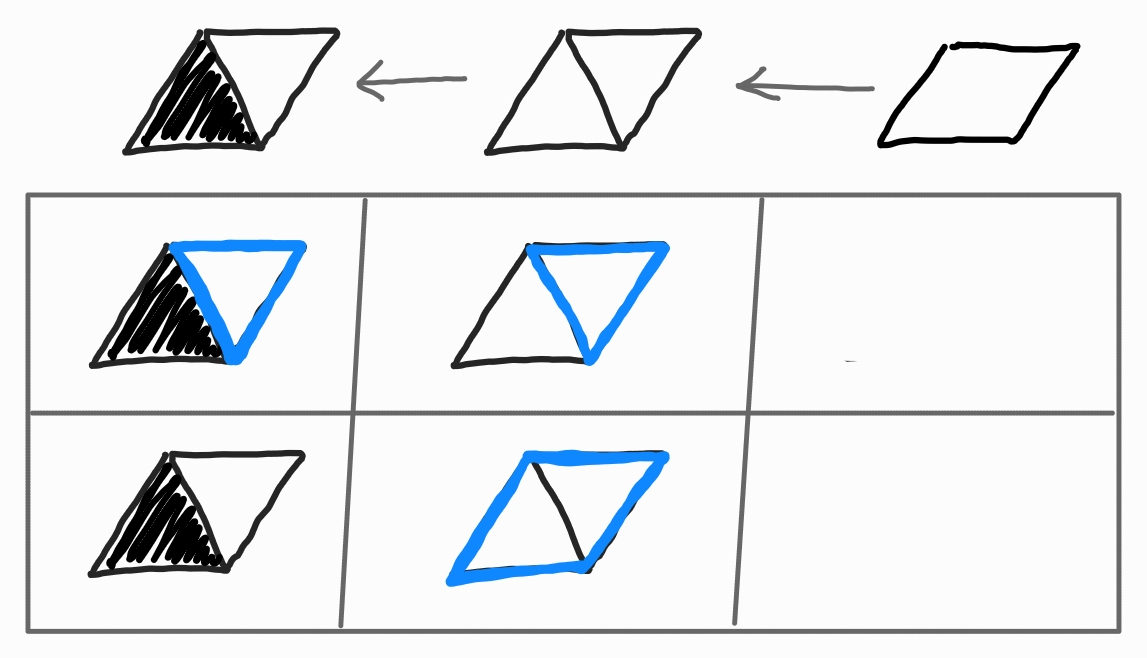
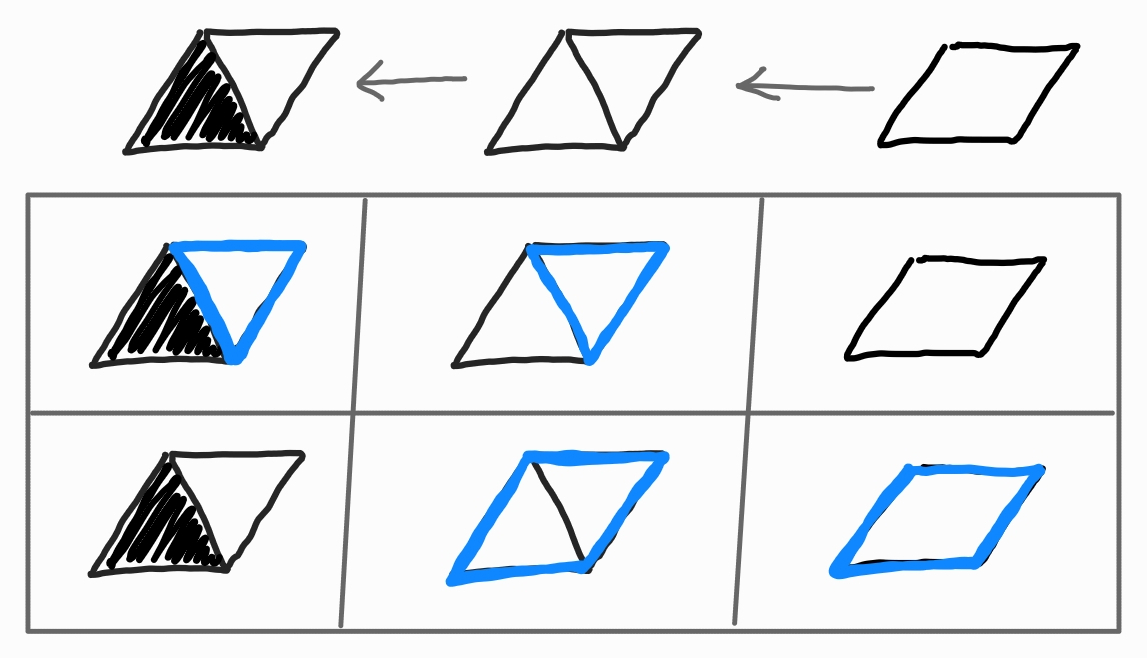
Explicit algorithm
We use a perfect HDVF
- initializeModules(): make a perfect HDVF, use \(g\)
- decompose(): use \(f\), solve a linear system of equations
- placeholderA1(), newCycleForward(): use \(\mathtt{I}\), \(g\)
- placeholderA2(): use \(\mathtt{I}\), \(\mathtt{A}\)
- placeholderB1(), newCycleBackward(): use \(\mathtt{R}\), \(\mathtt{D}\), \(g \circ f\)
- placeholderB2(): use \(\mathtt{W}\), \(\mathtt{D}\)




Explicit algorithm
We use a perfect HDVF
- initializeModules(): make a perfect HDVF, use \(g\)
- decompose(): use \(f\), solve a linear system of equations
- placeholderA1(), newCycleForward(): use \(\mathtt{I}\), \(g\)
- placeholderA2(): use \(\mathtt{I}\), \(\mathtt{A}\)
- placeholderB1(), newCycleBackward(): use \(\mathtt{R}\), \(\mathtt{D}\), \(g \circ f\)
- placeholderB2(): use \(\mathtt{W}\), \(\mathtt{D}\)
Time complexity: \(\mathcal{O}(n \cdot m^3 + n^2 \cdot m)\)
Row operations in RID + update perfect HDVF = extend RID
Improvements and Extensions
(spoiler: best for relative homology)
Efficient version of the algorithm
We avoid matrix inversions and multiplications:
- Operations \(\mathtt{I}\), \(\mathtt{D}\), \(\mathtt{A}\), \(\mathtt{R}\), \(\mathtt{W}\) in \(\mathcal{O}(m^2)\): reuse previous reduction maps
- decompose() in \(\mathcal{O}(m^2)\): update a change-of-basis matrix
Time complexity: \(\mathcal{O}(n m^3 + n^2 m) \longrightarrow \mathcal{O}(n m^2 + n^2 m)\)
Just the intervals
Ignore the previous columns of the RID
Time complexity: \(\mathcal{O}(n m^2 + n^2 m) \longrightarrow \mathcal{O}(n m^2)\) ✅
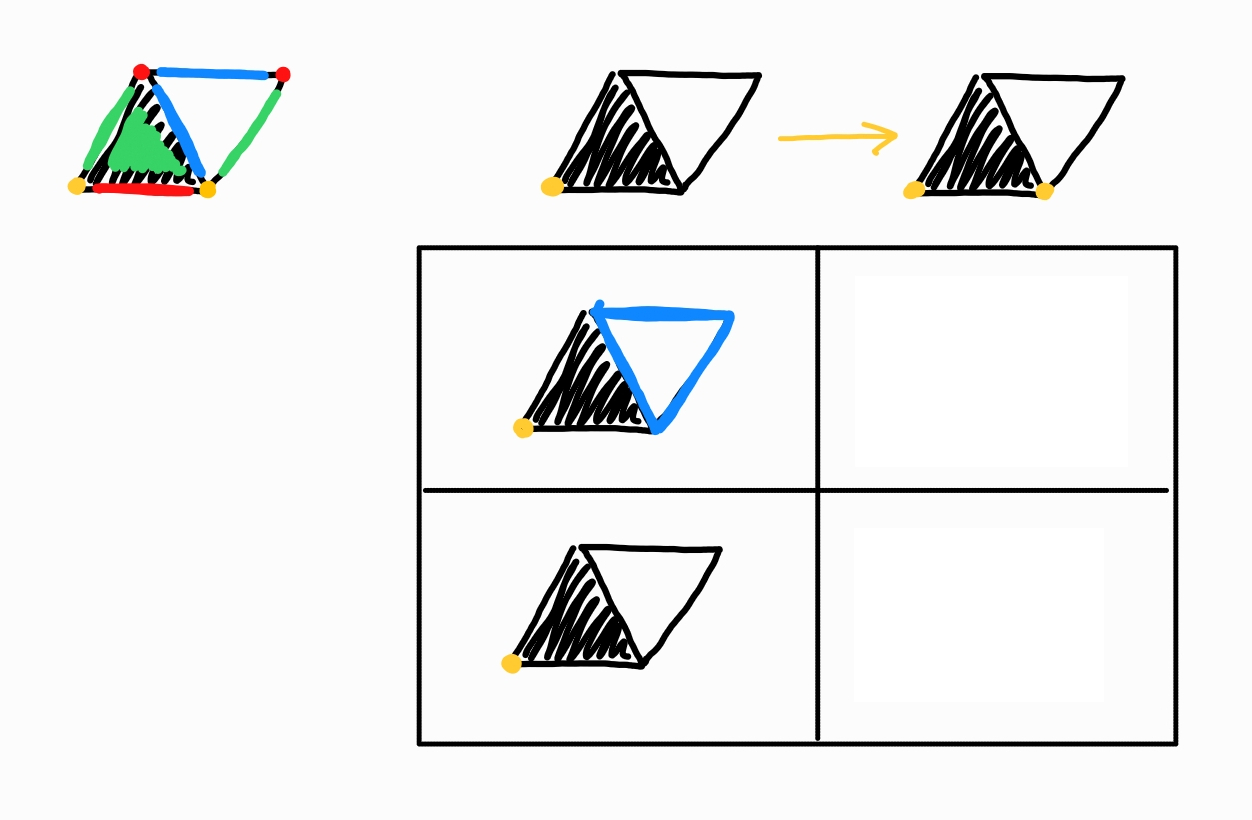
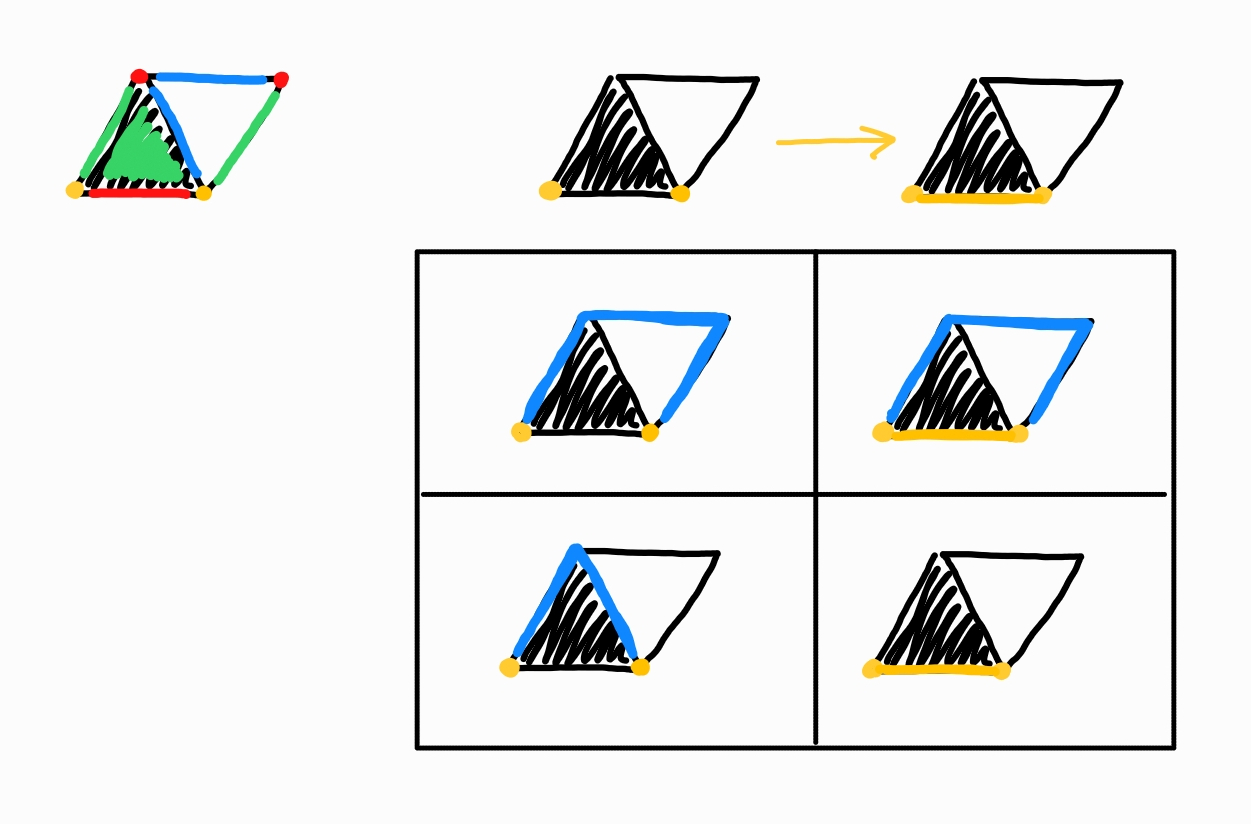
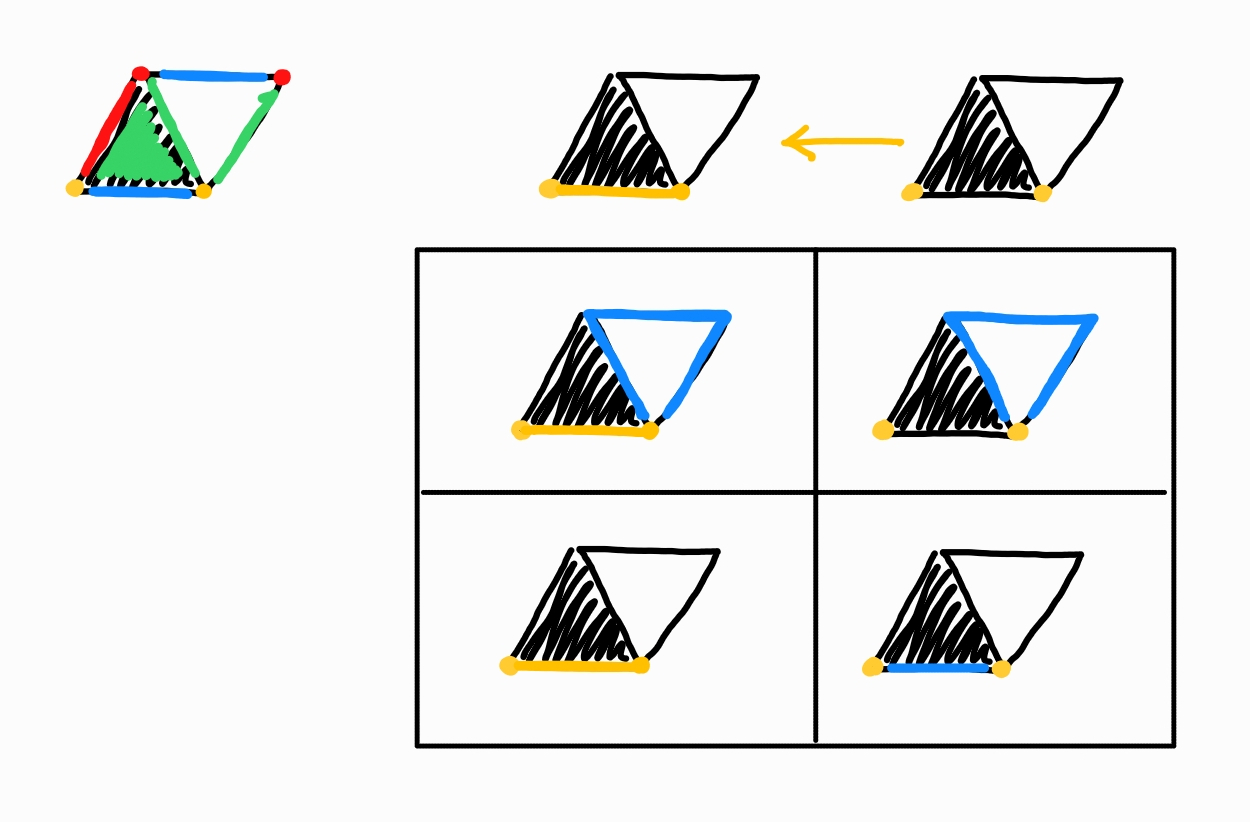
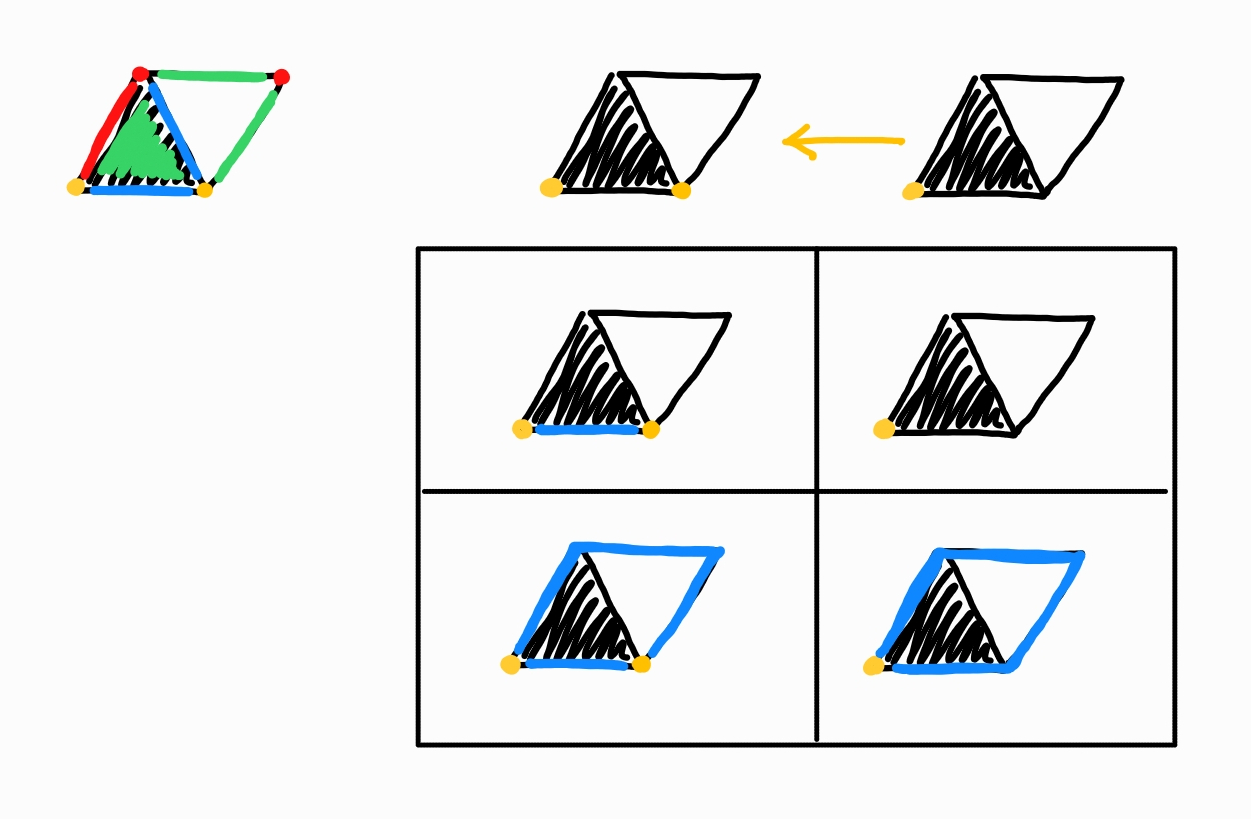
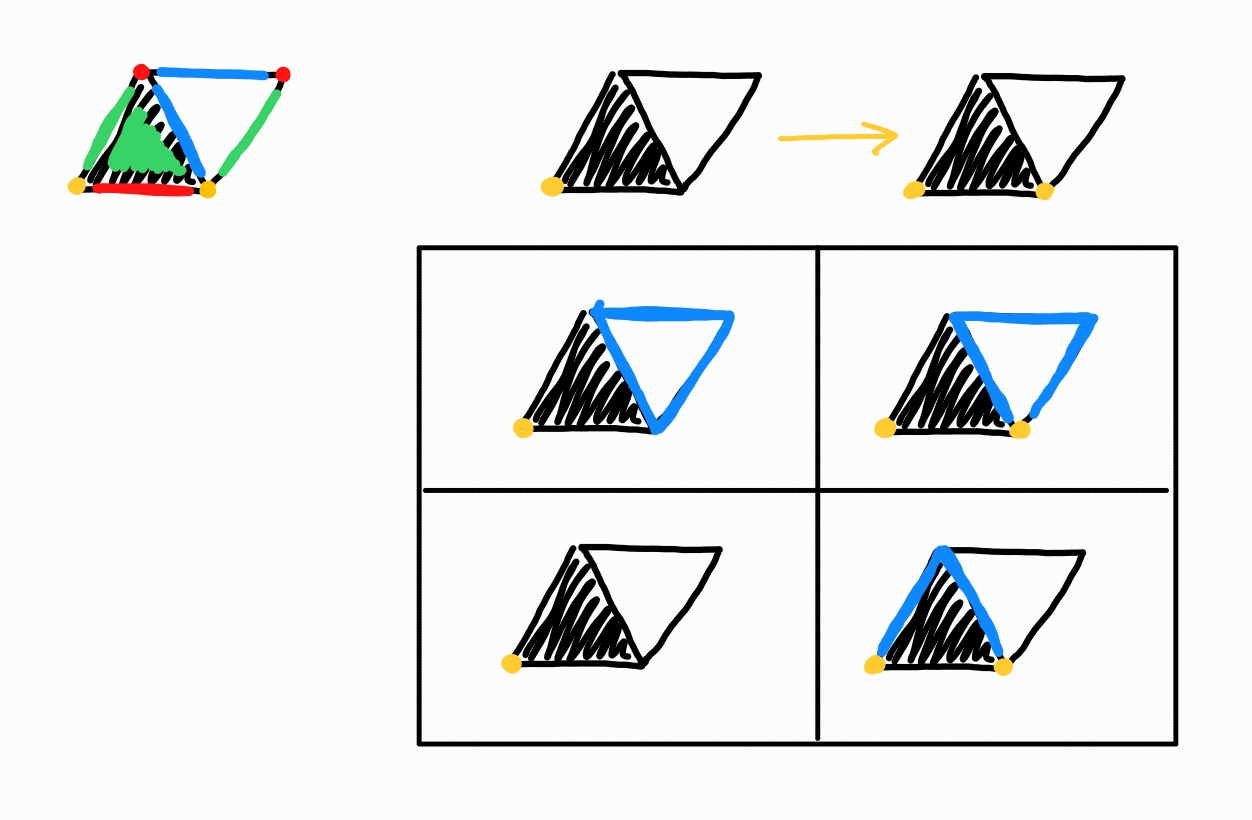
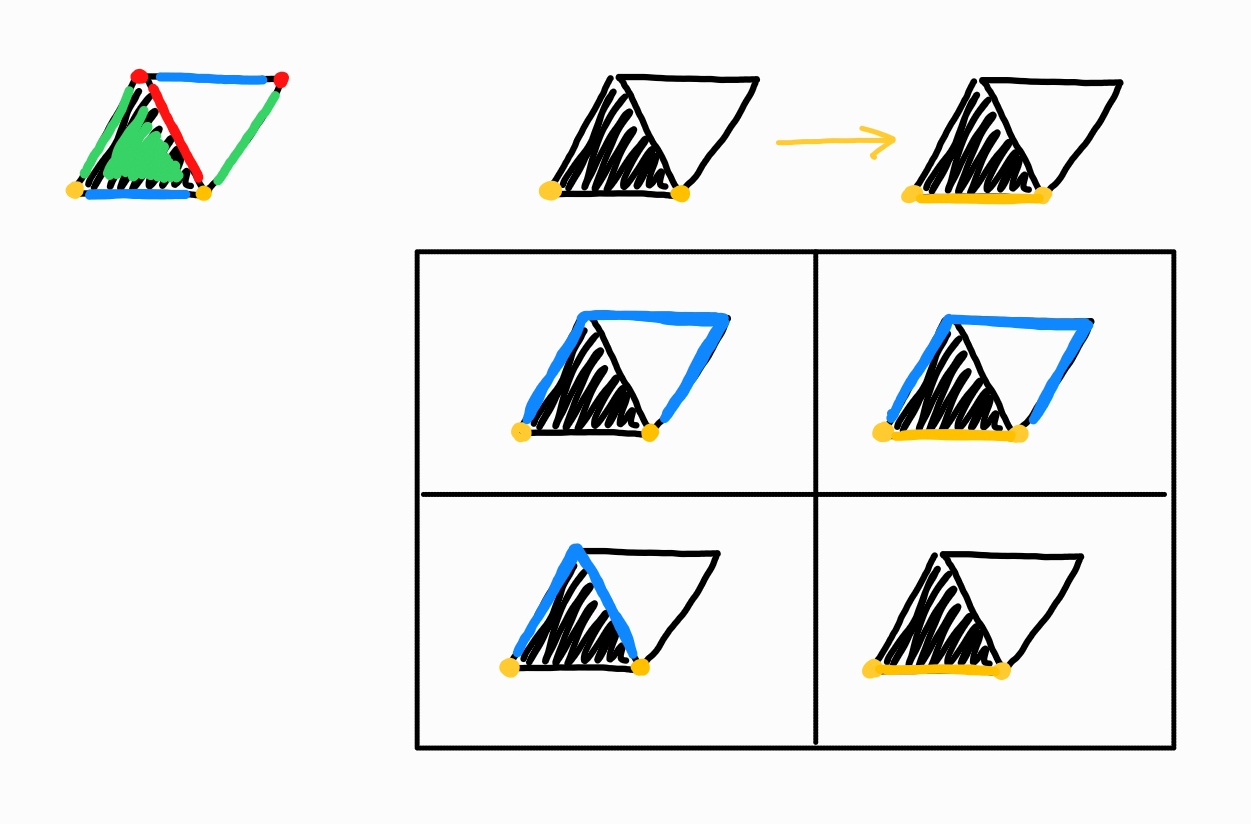
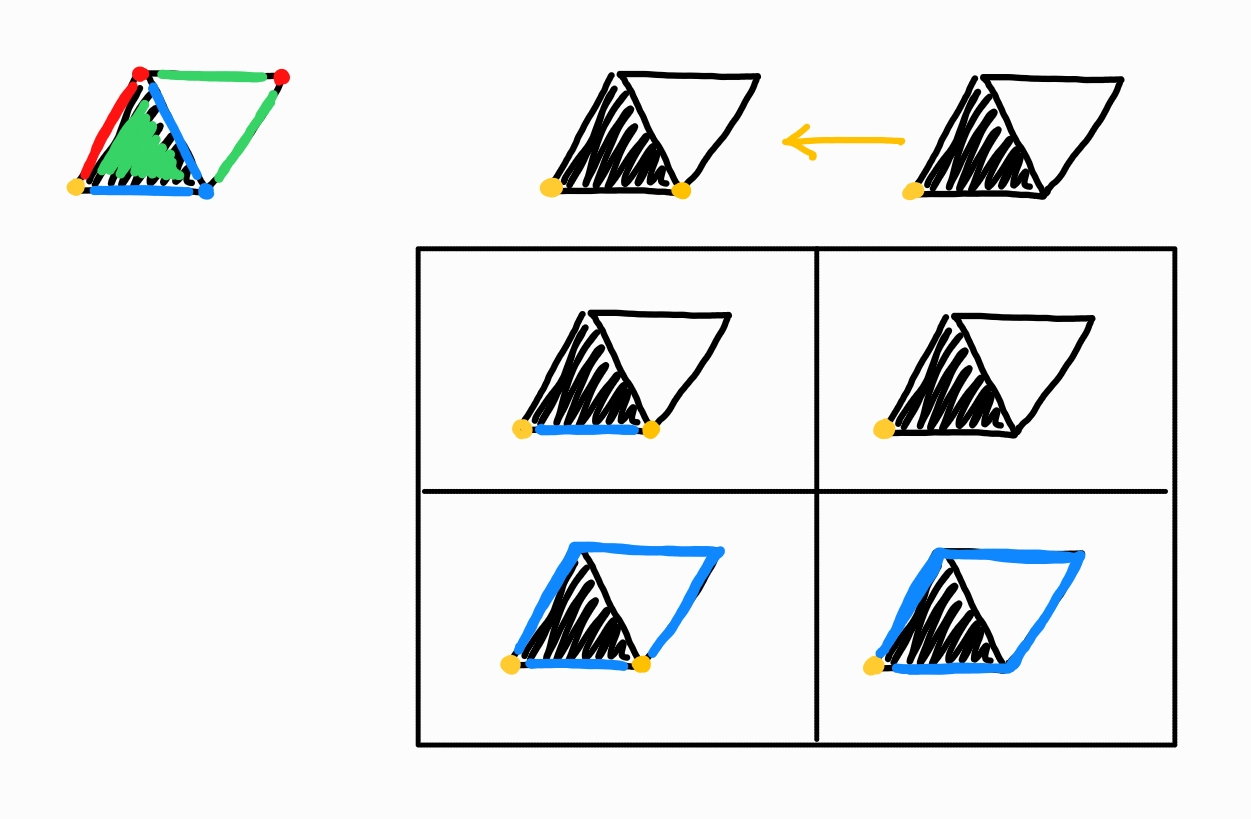
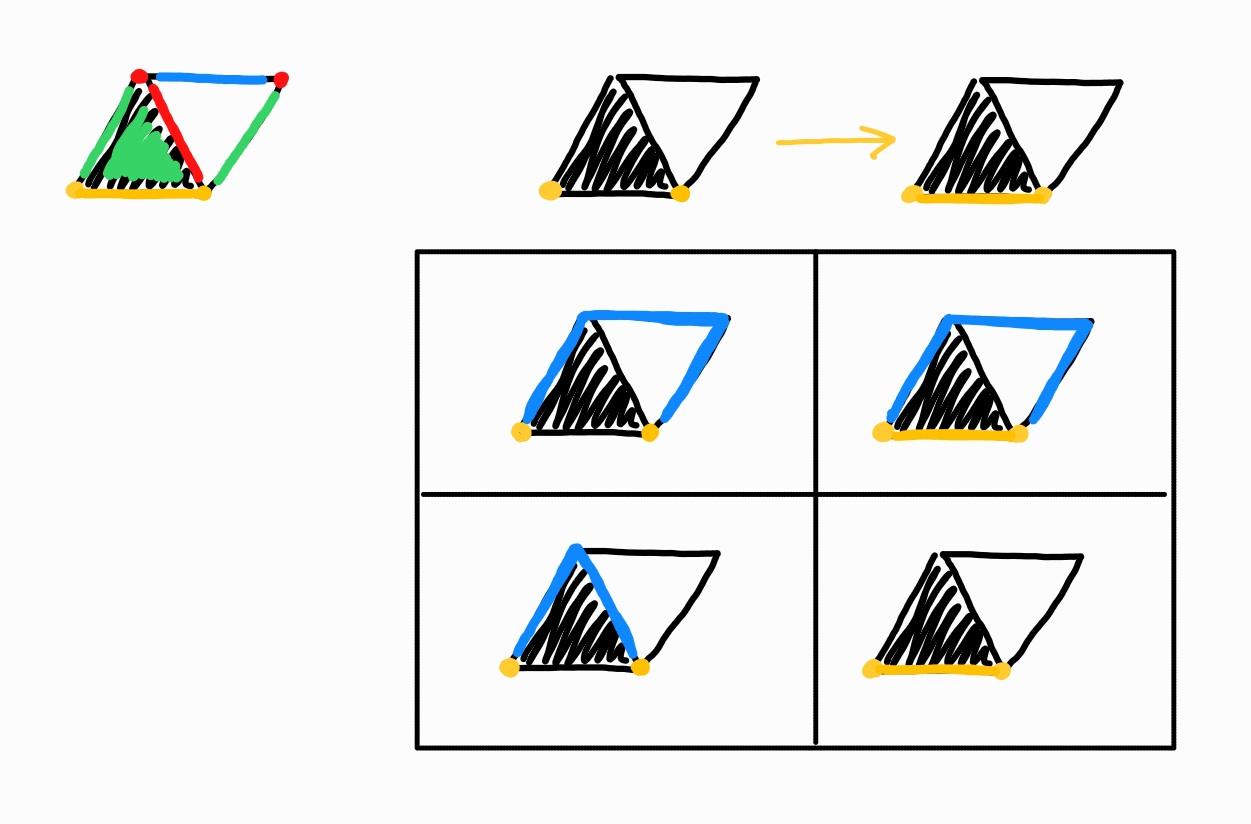
Extension for relative homology
If \(L \subset K\), then its relative homology group is \(H(K, L)\)

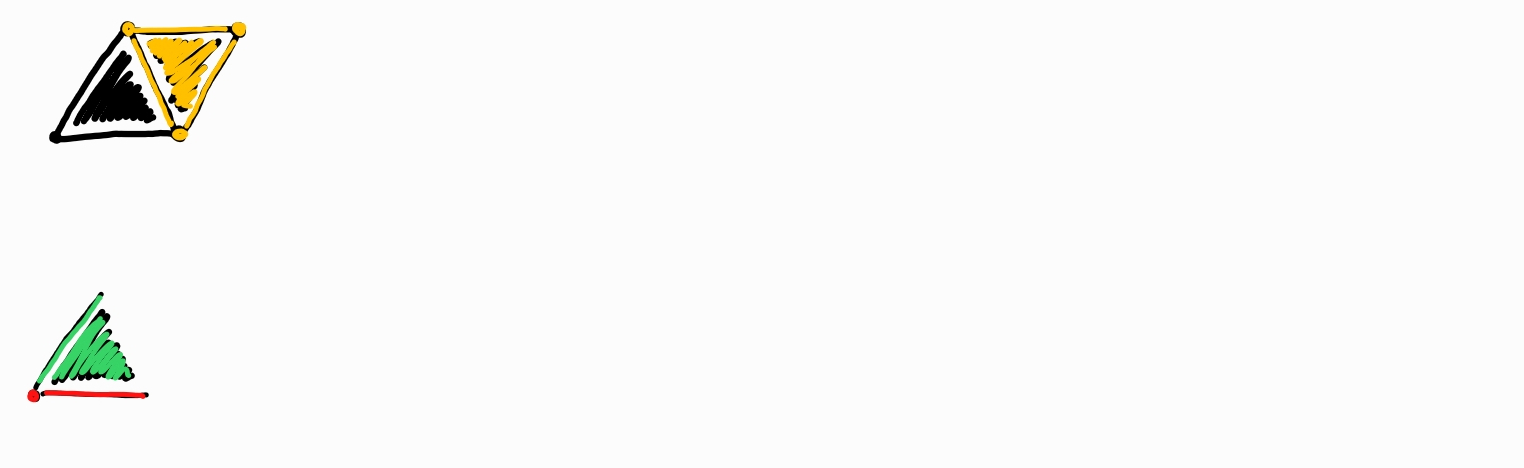
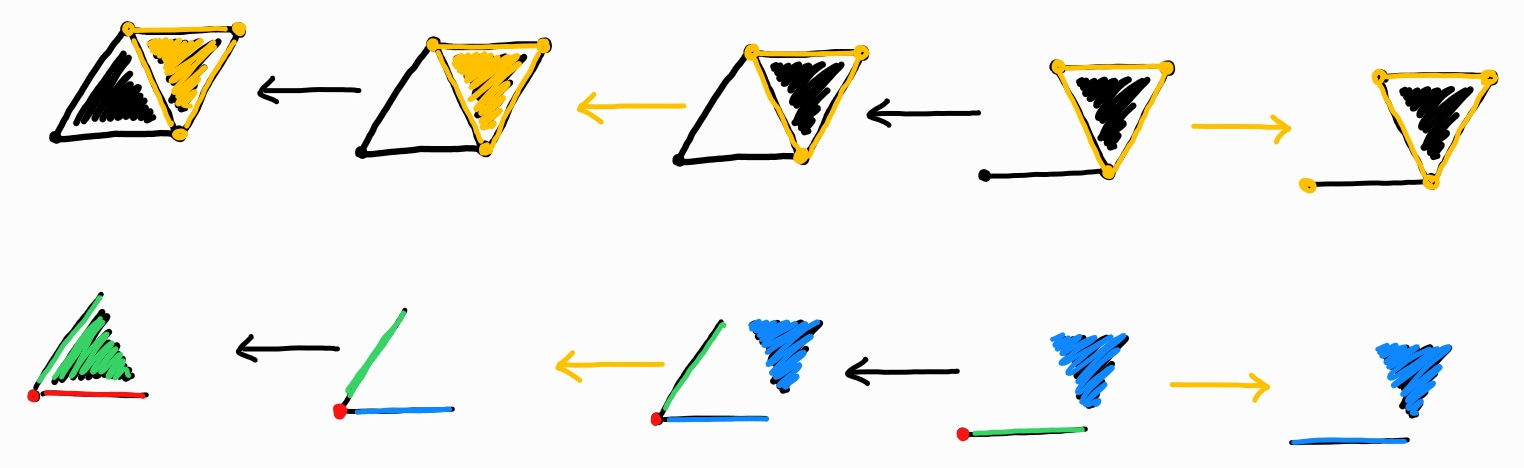
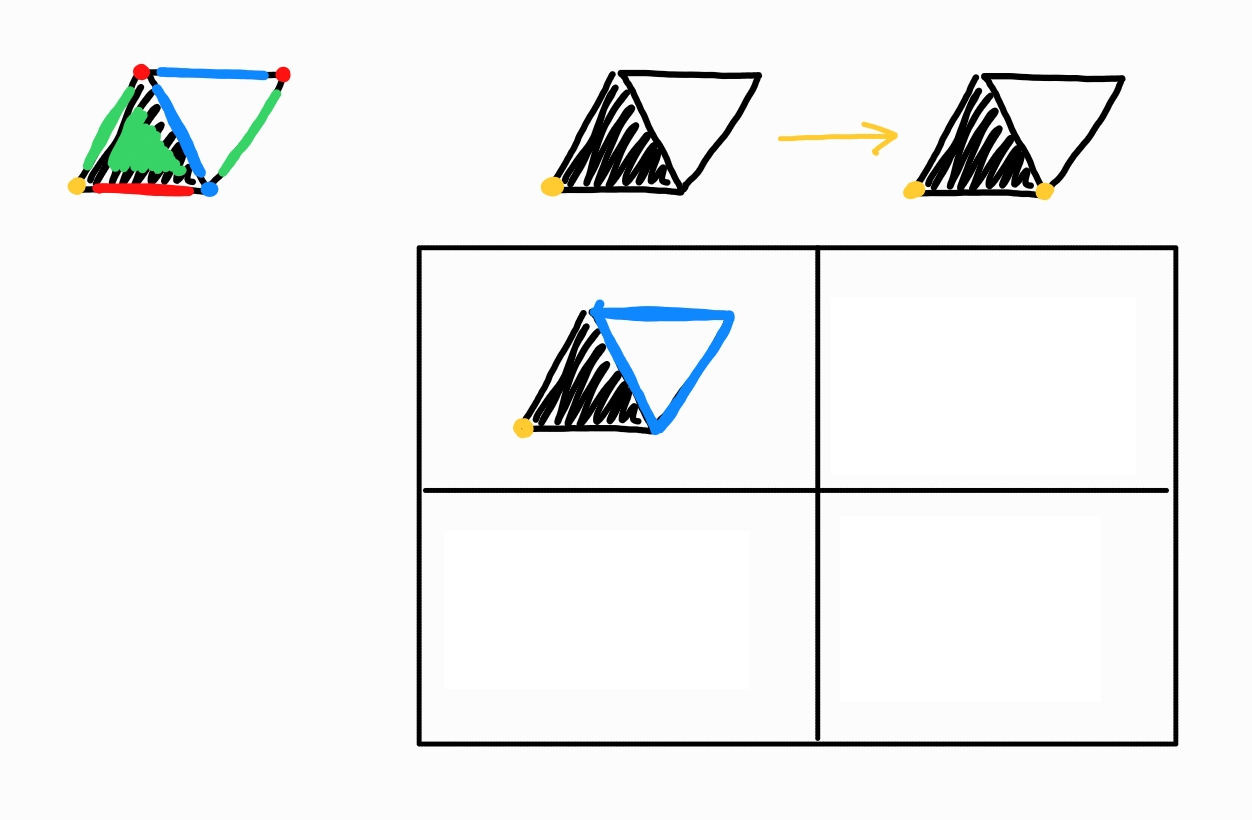
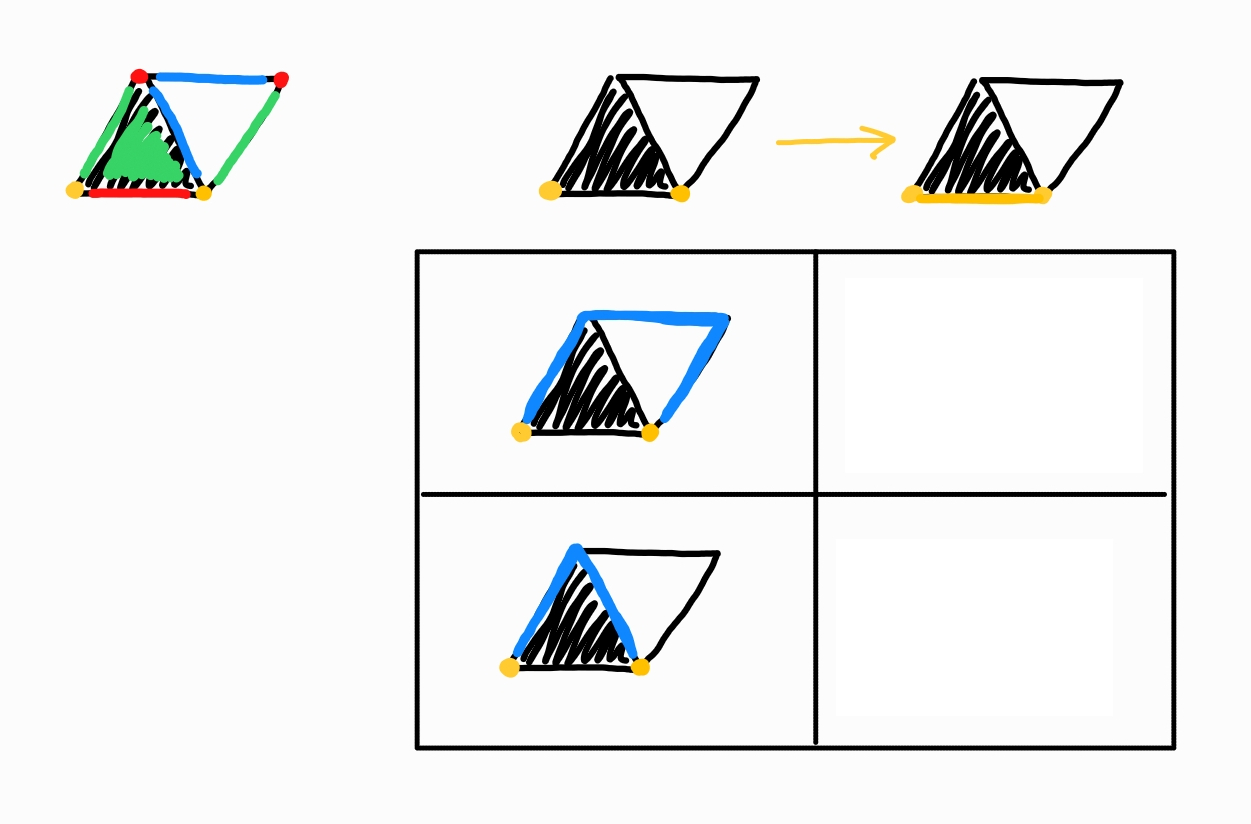
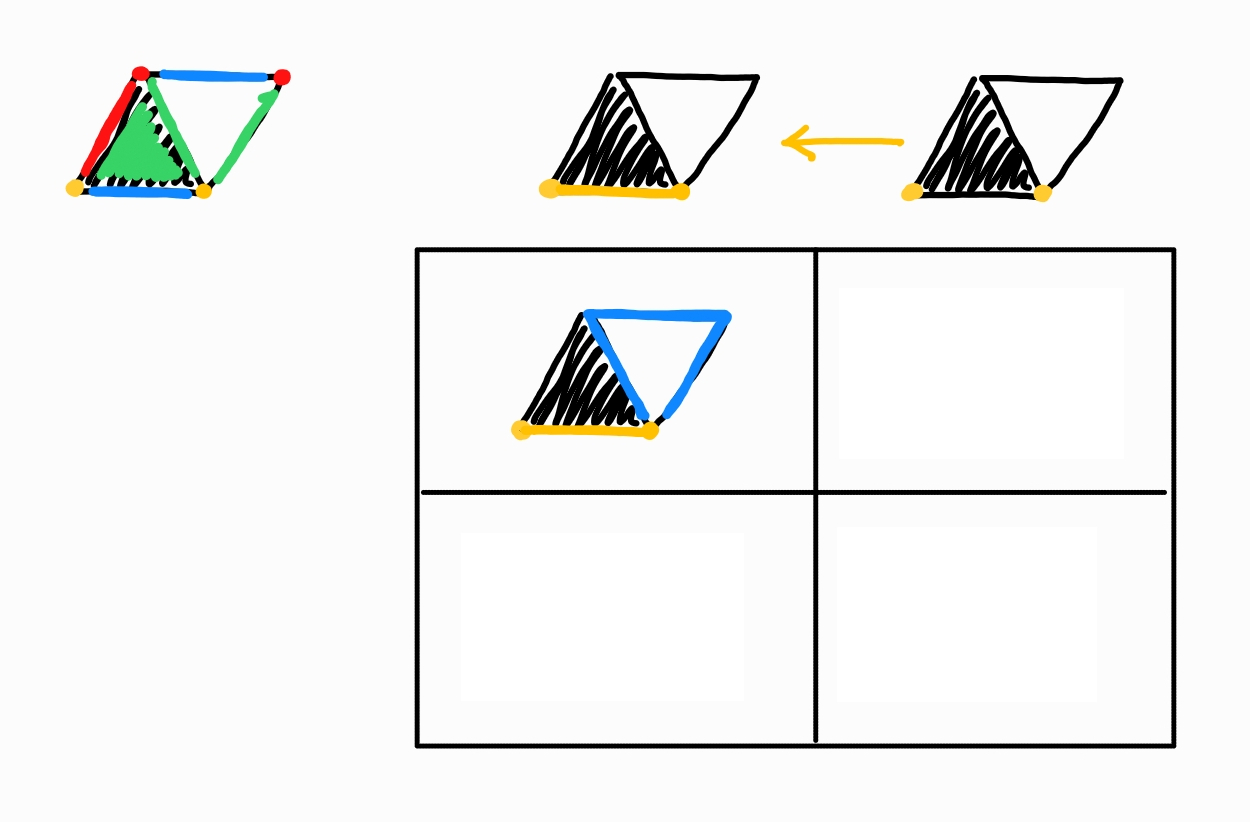
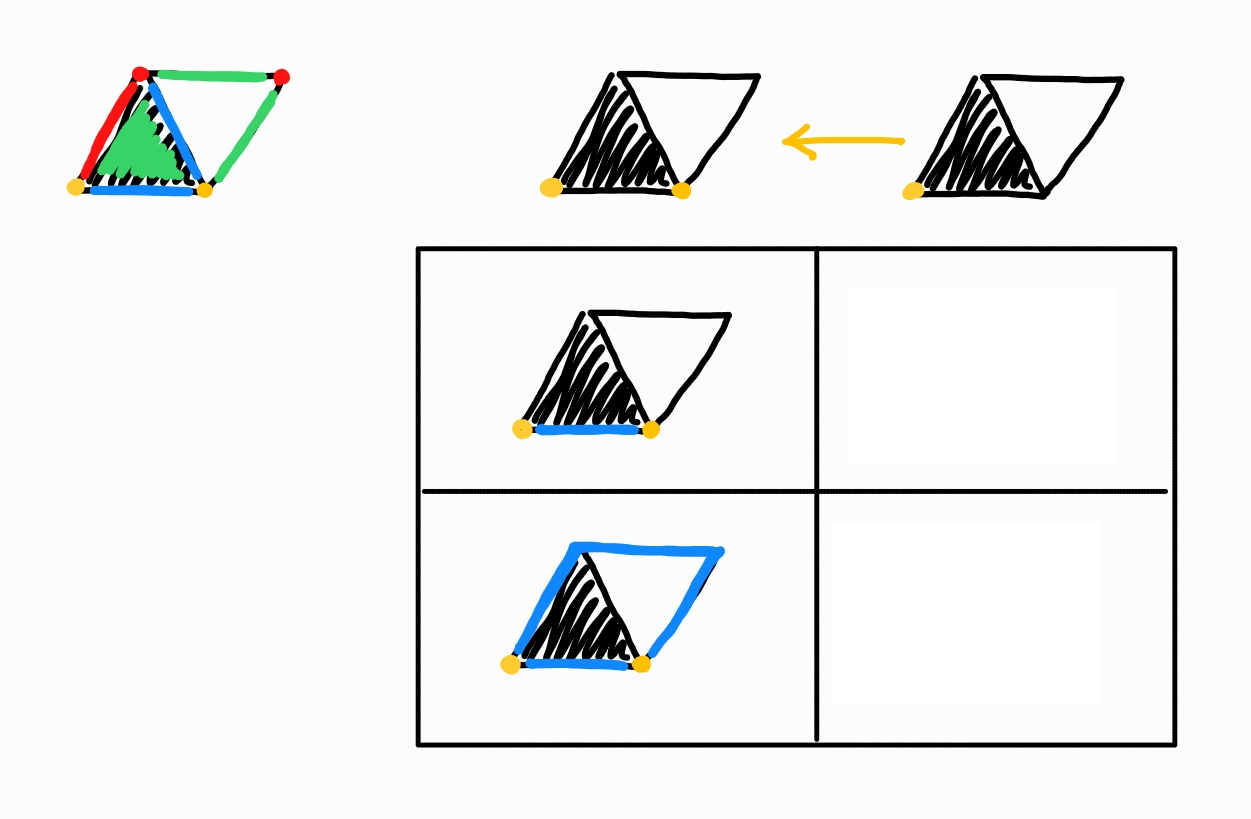
- Same algorithm, with four extra cases
- We also use operation \(\mathtt{W}\)
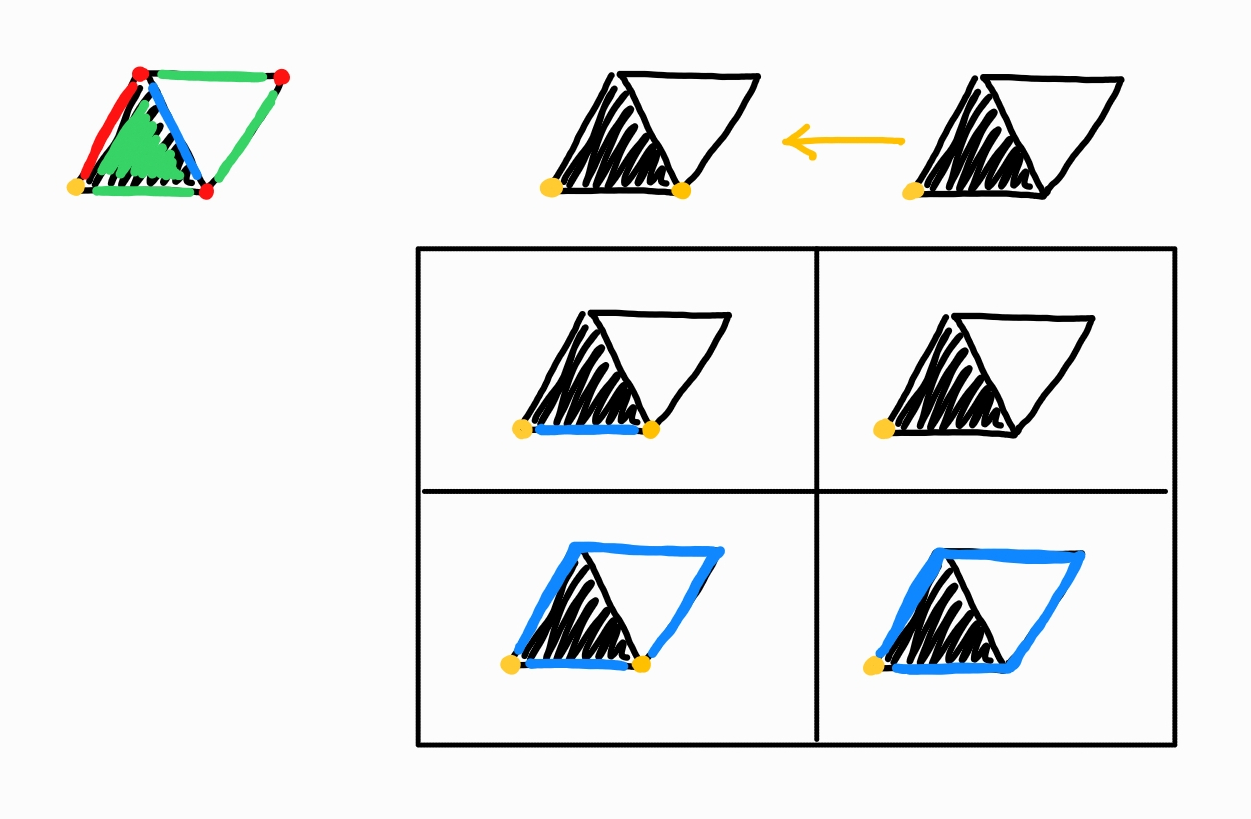
Time complexity: \(\mathcal{O}(n \cdot m^2)\), where
- n: number of steps in the filtration
- m: maximum \(|K - L|\)
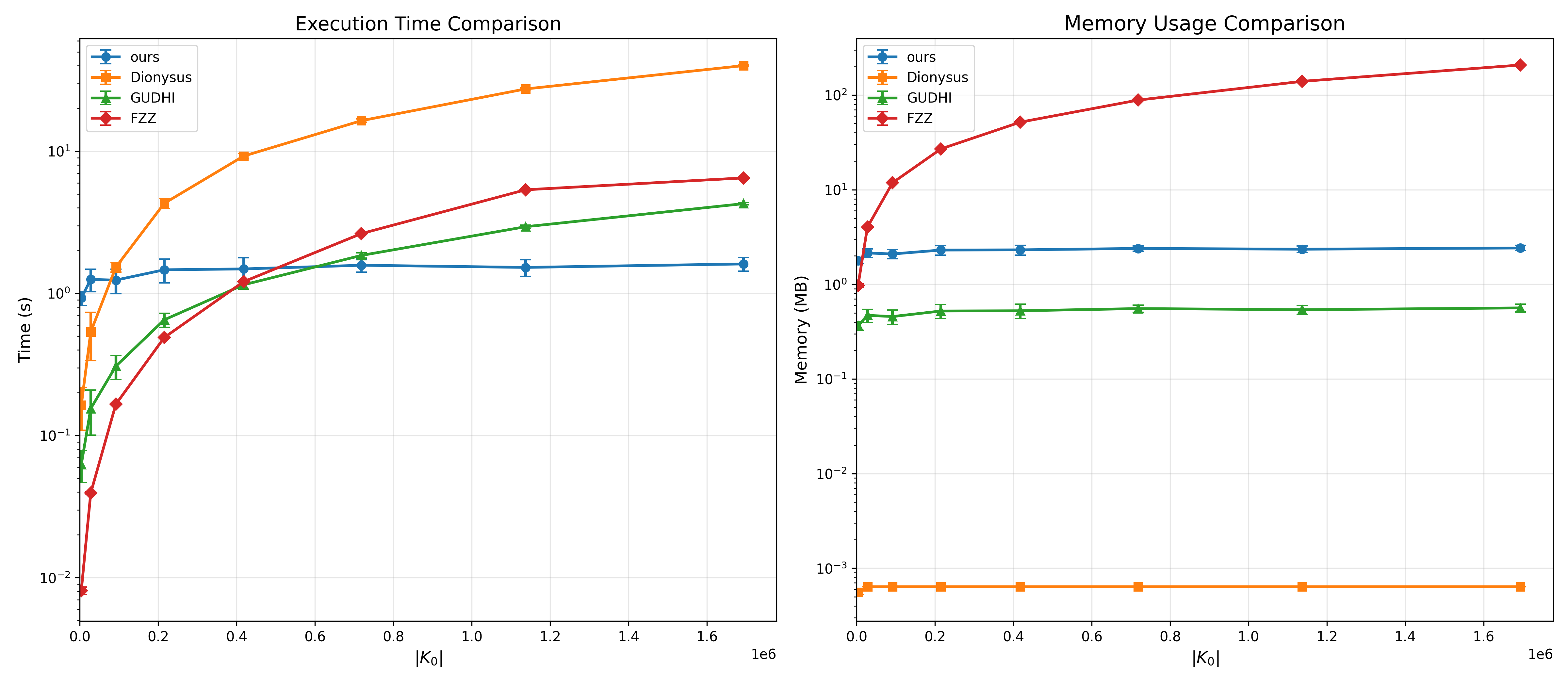
Best performance when \(|K-L| \ll |K|\)
Conclusion
In summary
- RID = zigzag persistent (relative) homology
- Practical algorithm
- How to use an HDVF
Future work
- Zigzag persistent relative cohomology
- Parallel algorithm: merge two RIDs
Thanks for listening. Questions?